For a long time, cloud adoption was framed as a simple milestone: move the infrastructure, gain scalability, and let the platform handle the rest.
That story was never entirely accurate, but early on it felt close enough.
Infrastructure teams could provision servers in minutes, scale capacity without buying hardware, and deploy applications faster than before. For many companies, that alone justified the move.
The problem is what happens later.
Once systems grow and real workloads start running through them, the cloud decision begins affecting far more than infrastructure. Finance starts asking why costs fluctuate month to month. Security teams begin mapping responsibility boundaries. Compliance teams need to understand where data actually lives and who controls it.
At that point, it becomes obvious that the cloud model wasn’t just a technical choice. It quietly shaped risk, governance, and cost structure across the organization.
That’s why the question of private versus public cloud deserves a broader conversation—one that’s often part of a larger cloud strategy conversation rather than a standalone infrastructure decision.
What Public Cloud Is Designed to Do
Public cloud platforms such as Amazon Web Services, Microsoft Azure, and Google Cloud Platform were built around a simple premise: shared infrastructure can deliver massive scale.
From a developer’s perspective, that scale unlocks several advantages.
Resources appear quickly. A server that once required procurement, installation, and configuration can now be launched in minutes. Capacity expands when traffic increases. Global regions allow applications to run closer to users without building new data centers.
For companies still finding their footing—or launching new products—those capabilities remove friction at exactly the right time.
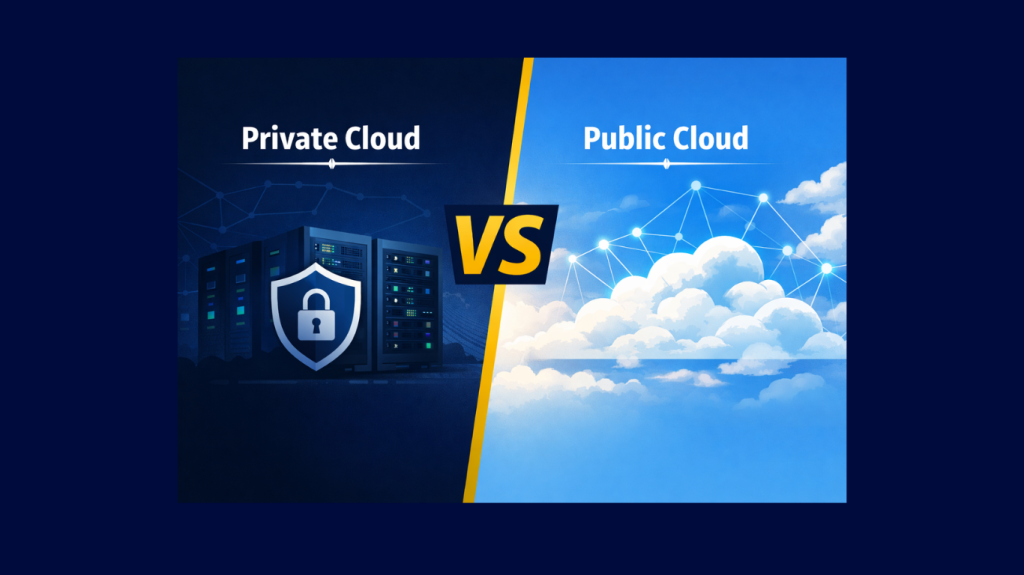
But public cloud achieves that flexibility through a shared model. Infrastructure is multi-tenant, meaning many customers rely on the same underlying systems. That arrangement is efficient, but it introduces tradeoffs that become more visible as environments mature.
Cost is usually the first surprise. Consumption-based pricing feels straightforward early on. As systems grow more complex, though, billing begins reflecting dozens of interconnected services. Storage tiers, data transfer, managed databases, and background compute jobs—each adds another layer.
Eventually, the question shifts from “How much does this service cost?” to “Why is our cloud bill unpredictable?”
Security and compliance introduce similar dynamics.
Providers maintain strong platform-level controls, but responsibility is divided. Teams still need to manage configuration, identity policies, network rules, and data protection. In large environments, that boundary can become difficult to monitor consistently.
None of this makes public cloud a poor choice. It simply means its strengths—speed, flexibility, and scale—come with responsibilities that grow over time.
What Private Cloud Prioritizes Instead
Private cloud takes a different path. Instead of sharing infrastructure across many organizations, the environment is dedicated to a single one.
Sometimes that infrastructure sits in an internal data center. In other cases, it’s hosted by a managed provider but isolated for one customer. Either way, the defining characteristic is control.
Network architecture can be designed exactly as needed. Security policies are enforced at every layer. Hardware resources are not shared with outside tenants.
For organizations handling sensitive data or operating under strict regulatory frameworks, those qualities matter.
Industries such as financial services, healthcare, and medical technology frequently face requirements around data residency, audit transparency, and operational oversight. In those environments, private infrastructure can simplify compliance rather than complicate it.
Of course, that control introduces its own responsibilities. Capacity planning becomes intentional instead of elastic. Infrastructure teams need automation, monitoring, and operational discipline to maintain reliability. Scaling is possible, but it requires planning rather than simply increasing usage.
For companies with predictable workloads and strong governance requirements, those tradeoffs can be worthwhile.
Why the Conversation Quickly Leaves Engineering
If this decision affected only system performance, engineering teams could resolve it themselves.
In reality, cloud architecture touches nearly every part of the organization.
Finance sees the billing model. Security evaluates exposure and policy enforcement. Compliance teams interpret regulatory requirements. Legal departments examine data residency obligations and contractual responsibilities.
Each group experiences the same infrastructure decision differently.
A public cloud platform might allow engineering teams to deploy features faster. At the same time, the finance team may struggle to forecast costs accurately. Security teams might inherit a growing list of configuration policies to monitor.
Conversely, a private environment may require greater operational investment while giving compliance teams clearer oversight and cost models that are easier to project.
Once those perspectives are considered together, the conversation stops being purely technical.
👋 What’s the biggest constraint shaping your cloud decision right now?
Cost predictability, compliance requirements, scalability, or something else—we’ll help you work through the tradeoffs.
Trusted by tech leaders at:



Cost Stability Versus Cost Flexibility
One of the clearest distinctions between cloud models appears in how costs behave over time. Public cloud pricing is inherently flexible. You pay for the resources you consume when you consume them. That structure works well for products with unpredictable growth patterns or rapidly changing workloads.
Eventually, though, variability can become difficult to manage. Leadership teams often want stable expectations for infrastructure spending. They need to understand how operational costs will behave as usage grows.
Private cloud environments tend to produce the opposite pattern. Initial investment is higher because capacity must be planned. Once infrastructure is in place, however, operating costs become more consistent.
Neither model guarantees lower spending. The difference lies in whether flexibility or predictability is more valuable at a given stage.
How Private and Public Cloud Impact the Business
Security Is About Governance, Not Location
There’s a persistent misconception that one cloud model is inherently safer than the other. In practice, security outcomes depend far more on governance than on where servers reside.
Public cloud platforms implement extensive security controls, but customers must configure and maintain their own policies. Access management, network segmentation, and data protection remain the responsibility of the organization using the platform.
Private cloud environments shift that responsibility inward. Teams gain full visibility and control, but they also carry the entire operational burden.
In both cases, the effectiveness of security ultimately reflects the maturity of the organization managing it.
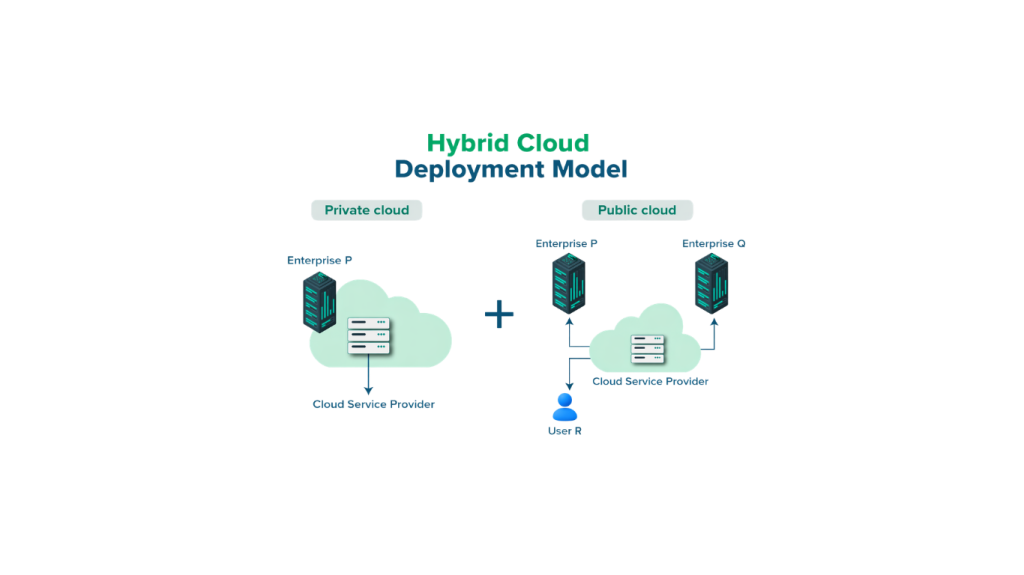
Why Many Organizations End Up Hybrid
Because each model solves different problems, many companies eventually combine them. Sensitive workloads or regulated data may remain in private environments, while public cloud handles burst capacity, experimentation, or globally distributed services. That approach allows teams to match infrastructure to the needs of individual workloads rather than forcing everything into a single pattern.
Hybrid architectures aren’t a compromise. They’re often the natural result of aligning technology with business constraints.
The Questions That Actually Matter
When organizations evaluate private versus public cloud, the most useful discussions usually revolve around a few practical questions.
How predictable are your workloads?
What regulatory requirements govern your data?
How much cost volatility can the business tolerate?
Where is full architectural control necessary?
How quickly do you expect your systems to evolve?
Answering those questions honestly reveals which model fits best.
Architecture Should Follow Risk, Not Trends
Infrastructure choices rarely fail because the technology was flawed. More often, the underlying assumptions were misaligned with how the organization eventually needed to operate.
Cloud decisions are a good example. What looks efficient in the early stages can become restrictive years later if governance, compliance, or cost stability were not considered upfront.
Choosing between private and public cloud is ultimately about aligning infrastructure with business risk and operational realities—not simply following whichever model is most popular at the moment.
If your team is evaluating cloud options and wants a clearer understanding of the architectural tradeoffs involved, Curotec helps organizations assess workloads, compliance requirements, and long-term growth plans before committing to infrastructure decisions that are difficult to unwind later. Talk to our team about your cloud strategy before you commit to the wrong architecture.
FAQs
Is private cloud more secure than public cloud?
Not by default.
Public cloud providers invest heavily in security, but you’re still responsible for how things are configured. Private cloud gives you more control, but that also means more responsibility.
In the end, security usually reflects how well the environment is managed—not which model you chose.
Is public cloud always cheaper than private cloud?
At the beginning, often yes. Over time, not always.
Public cloud costs can creep up in ways that aren’t obvious at first—data transfer, idle resources, overlapping services. It adds up.
Private cloud is more upfront, but easier to predict once things are running. So it really depends on how stable your workloads are
When does private cloud make more sense?
Usually when control matters more than flexibility.
That tends to be the case with regulated environments, sensitive data, or systems that don’t change much day to day. If you already know what your workload looks like, private cloud can feel more stable.
When should a company choose public cloud?
When things are still moving.
If you’re building quickly, testing ideas, or dealing with uneven demand, public cloud makes that easier. You don’t have to commit to infrastructure before you fully understand what you need.
Why do so many organizations end up with a hybrid cloud model?
Because one environment rarely fits everything.
Some workloads need tighter control—whether that’s for compliance, data sensitivity, or predictable performance. Others benefit from the flexibility of public cloud. Over time, companies start placing systems where they make the most sense.
It’s usually not a planned decision at the start. It’s something that evolves as constraints become clearer.
Can you move from public cloud to private cloud later?
You can, but it’s rarely quick.
The more you rely on cloud-native services, the harder it gets to unwind. What starts as a lift-and-shift can turn into a full re-architecture.
It’s doable—just not something you want to underestimate.
What is the biggest mistake companies make when choosing a cloud model?
Focusing too much on cost upfront.
It feels like the most concrete factor, but it’s not usually the one that causes problems later. Risk, compliance, and operational complexity tend to matter more over tim