
Modernizing a Java monolith can feel a little like updating a house while you still live in it: you want better structure, modern plumbing, and more room to grow, but you can’t just bulldoze it and hope for the best. And yet, that’s the situation countless engineering teams find themselves in. Their most essential applications—sometimes 10, 15, or even 20 years old—still run mission-critical workflows, but the cracks are showing. Release cycles slow to a crawl, brittle code makes every change feel risky, and scaling the app becomes a game of JVM tuning and crossed fingers.
The good news? Modernization doesn’t have to mean a massive rewrite that swallows years and budget. With the right approach, teams can evolve a monolith step by step, improving stability and speed while keeping the business running without interruption. This guide walks through what “legacy” really means, which modernization paths work best, and how to get started without breaking what already works.
What Makes a Java Monolith “Legacy”?
Not every large application is legacy. A well-structured monolith can be perfectly maintainable. But over time, certain patterns emerge that make a system more difficult to evolve.
Architectural signs
- Modules depend heavily on one another, making it challenging to change one area without affecting another
- A single shared database schema with sprawling tables
- Few or unclear domain boundaries
Code-level signs
- Older frameworks like Struts, EJB, or early Spring versions
- Business logic is scattered unpredictably across layers
- Sparse or nonexistent automated testing
- Duplicate logic that builds up because refactoring feels dangerous
Operational signs
- Slow, manual deployments
- Infrastructure tied to physical servers or older VMs
- Limited logging and monitoring, making troubleshooting slow and reactive
If your system matches several of these, modernization could unlock meaningful improvements in developer confidence and business agility.
Before You Modernize: Set the Right Goals
It’s tempting to jump straight into tools, frameworks, or containerization, but the most successful modernization efforts start with clarity.
Define what success looks like.
Do you want faster deployments? Cloud portability? Improved reliability? Lower onboarding friction for new developers? Each of these leads to a slightly different modernization path.
Know your constraints.
Compliance, data residency rules, existing SLAs, and the current team’s skill set all shape what’s practical. Some organizations can overhaul infrastructure quickly; others need to move more slowly because availability requirements won’t budge.
Finally, take an honest look at the system.
Perform a simple audit: map domains, identify dependencies, document performance hotspots, and surface areas that cause the most developer friction. You don’t need a months-long assessment to get started—just enough direction to avoid surprises later.
Modernization Approaches to Consider
Not every organization needs the same level or style of modernization. Broadly, you have three options:
Big-Bang Rewrite
It sounds appealing: start fresh, build the ideal system, and leave all the legacy issues behind. But big-bang rewrites are risky and expensive. They often take years, and by the time you finish, requirements have shifted.
Lift-and-Shift
Here, you move the monolith to modern infrastructure—usually containers or cloud—without altering the code. It’s fast and low-risk, and you get operational benefits immediately. But it won’t fix the structural issues inside the application.
Incremental Modernization (recommended)
This is the “renovate while you live in the house” model. You improve the system piece by piece, starting with small wins and working outward. It’s how most successful enterprise teams modernize today because it spreads out cost, reduces risk, and keeps the system stable.
Incremental modernization also pairs perfectly with one powerful approach: the strangler fig pattern.
How the Strangler Fig Pattern Works
The strangler fig pattern gives you a playbook for evolving a monolith without downtime. Rather than rewrite everything at once, you build new functionality around the monolith and gradually shift traffic to it. Over time, the legacy parts shrink and “fade out,” just like a strangler fig tree overtaking its host.
Here’s the basic flow:
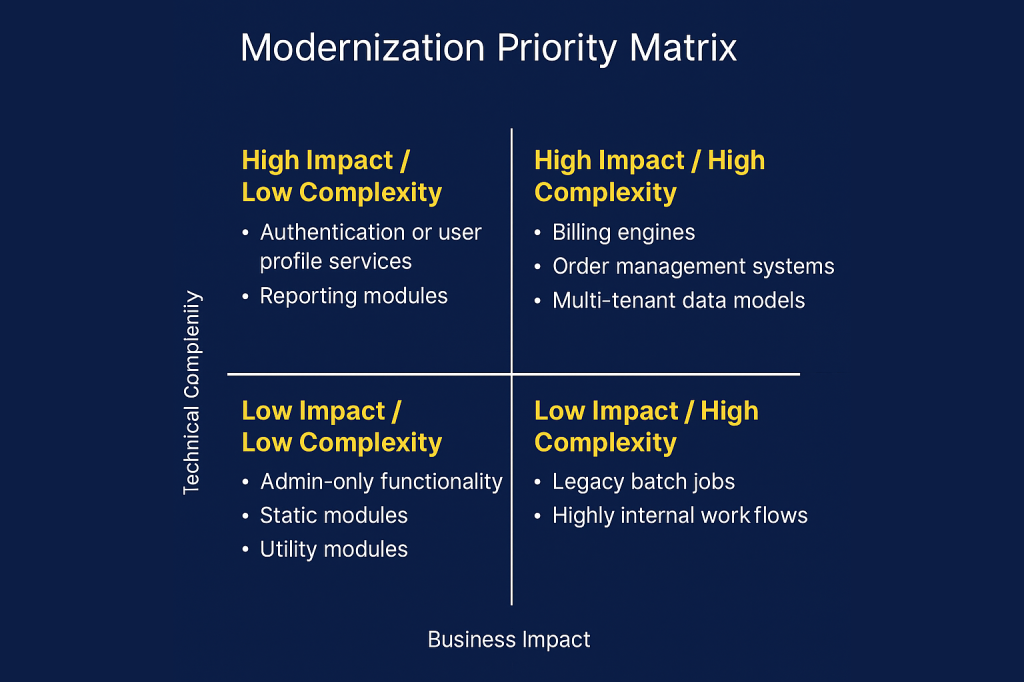
- Identify a clean domain, like authentication or billing
- Build a modern service that handles that domain
- Route requests for that capability through a gateway or façade
- Retire the monolith’s version once traffic has entirely shifted
This gives you a controlled, low-risk way to modernize—and the business sees progress continuously instead of waiting years for a complete rebuild.
If you want a deeper dive into the technique, check out our dedicated post on using the strangler fig pattern for legacy modernization, which walks through practical examples and visual models.

A Step-by-Step Modernization Plan
Now that the approach is straightforward, here’s a practical roadmap you can follow.
Step 1 — Modernize the Foundation
Before extracting anything, update what’s already there.
- Upgrade to a current Java LTS release
- Remove or replace outdated frameworks
- Introduce automated testing—unit, integration, and regression tests where possible
- Clean up, build, and dependency management with Maven or Gradle
These changes make the system more predictable and easier to evolve.
Step 2 — Containerize the Monolith
Even if you’re not ready for microservices, containerization is a big step forward.
- Package the monolith as a Docker image
- Externalize configuration so it can run consistently across environments
- Prepare for cloud-native deployment (Kubernetes, ECS, etc.)
This gives you reproducibility, scalability, and simpler release processes.
Step 3 — Add Observability Early
Once you start splitting services, you’ll want visibility into how they behave.
- Structured logging
- Metrics and dashboards (Prometheus, Grafana, Micrometer)
- Distributed tracing with OpenTelemetry, Jaeger, or Zipkin
Observability makes modernization safer because you can see what’s happening as you make changes.
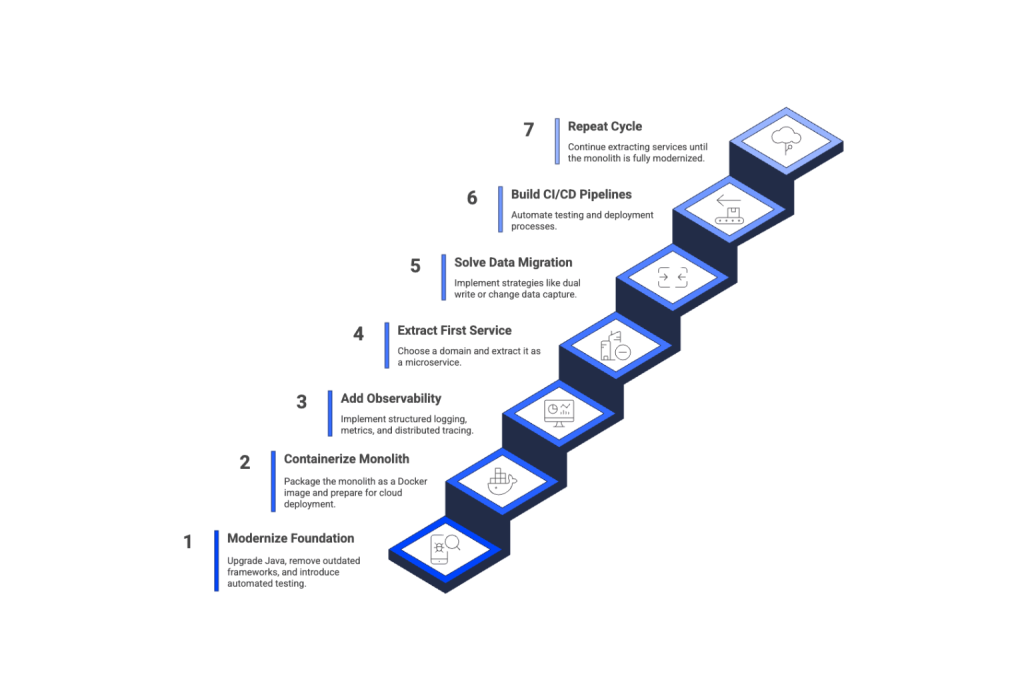
Step 4 — Extract the First Service
Pick a domain with clear boundaries—not the hardest, but not trivial either.
- Introduce an API gateway or reverse proxy to manage routing
- Decide how the new service communicates with the monolith (REST, messaging, gRPC)
- Determine whether data will remain in the shared database for now or move to its own schema
This first extraction builds confidence and creates patterns you’ll reuse for the next ones.
Step 5 — Solve Data Migration Challenges
Data is often the trickiest piece of modernization. Common strategies include:
- Dual write: both systems temporarily write to the same dataset
- Change data capture: tools like Debezium track database changes and sync them to new services
- Event-driven migration: new services consume events as the source of truth
You don’t need a perfect long-term data strategy on day one—just one that works for the domain you’re migrating.
Step 6 — Build Modern CI/CD Pipelines
As components become more modular, automation becomes essential.
- GitHub Actions, GitLab CI, or modernized Jenkins pipelines
- Automated tests in the build pathway
- Blue-green or canary deployments
- Infrastructure as code for consistent environment provisioning
This ensures your modernization effort leads to faster delivery, not slower.
Step 7 — Repeat the Cycle
Once one service is stable, pick the next domain and repeat the process. Over time, the monolith shrinks, complexity drops, and the architecture naturally becomes more modular and resilient.
👋 What Java modernization challenges are you looking to solve?
Share a few details and our team will help you identify the fastest path forward.
Trusted by tech leaders at:



Pitfalls to Avoid
Even with a solid plan, modernization can stumble if you’re not careful.
- Extracting too many services at once leads to chaos
- Allowing “just this one piece” to turn into a rewrite
- Postponing observability, which makes debugging impossible
- Ignoring product timelines—modernization should support business goals, not block them
Success comes from steady progress, not perfection.
Modernizing a legacy Java monolith isn’t about flipping a switch. It’s about carving a path that respects what already works while giving your team the tools and structure to move faster. By focusing on incremental change, prioritizing observability, and leaning on proven approaches like the strangler fig pattern, organizations can evolve their systems with far less risk than a complete overhaul. Start small, learn with each iteration, and let the architecture improve piece by piece.
How Curotec Can Help
If you’re planning to modernize a Java monolith and want a partner who’s handled everything from strategic roadmapping to hands-on implementation, Curotec can help. Our team works closely with engineering organizations to modernize legacy systems using proven, low-risk approaches, including incremental refactoring, microservice extraction, cloud migration, and CI/CD automation. Reach out to explore what a phased, practical modernization plan could look like for your organization.