Most teams don’t sit down and decide how they want to scale an application. They discover their scaling strategy by accident.
It shows up when traffic spikes, when a database upgrade requires downtime, or when a single server becomes “too important to fail.” At that point, the discussion usually narrows to two options: make the existing system bigger, or start spreading the load across multiple machines.
That choice — vertical versus horizontal scaling — ends up shaping far more than performance.
What Scaling Really Means in Practice

At a high level, scaling is about handling growth. But in real systems, growth rarely shows up as a single clean metric.
Sometimes it’s traffic spikes. Sometimes it’s heavier data processing. Other times, it’s more users doing more complex things simultaneously. Scaling is your system’s ability to absorb those changes without degrading the experience—or exhausting the team maintaining it.
This is why scaling decisions are architectural decisions, not just infrastructure upgrades. The approach you take influences deployment workflows, failure tolerance, and even how confidently you can ship new features.
What Is Vertical Scaling
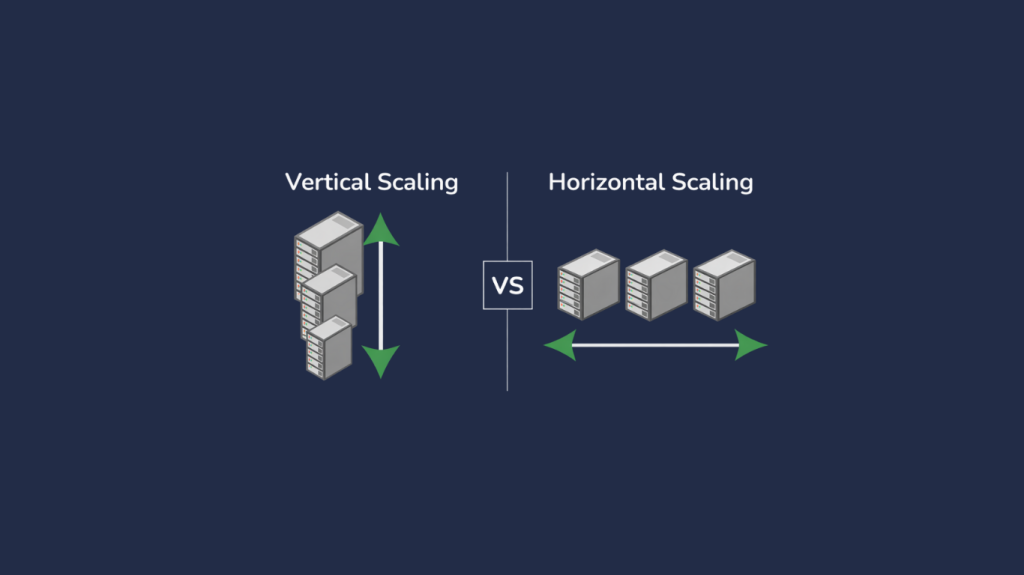
Vertical scaling, often called “scaling up,” is the most straightforward approach.
Instead of changing your system, you give the existing machine more resources. More CPU. More memory. Faster disks. Bigger boxes.
For many teams, this is the first scaling step because it feels safe and familiar.
Common Vertical Scaling Use Cases
Vertical scaling tends to show up in environments like:
- Early-stage applications that haven’t hit meaningful load yet
- Monolithic systems where breaking things apart isn’t feasible
- Legacy platforms that were never designed for distribution
If your application lives on a single server and performance issues are predictable, vertical scaling often buys you time.
Benefits of Vertical Scaling
There’s a reason teams reach for this option first:
- It’s quick to implement
- It requires little to no architectural change
- Performance gains are usually immediate and easy to measure

In many cases, vertical scaling is the lowest-risk way to stabilize a system under pressure.
Limitations of Vertical Scaling
The simplicity doesn’t last forever.
Every machine has a ceiling. Once you hit it, the only options left are expensive or disruptive. Vertical scaling also concentrates risk. If that one machine goes down, everything goes with it.
Over time, costs rise sharply while returns diminish, and upgrades often require downtime—something modern users are increasingly intolerant of.
What Is Horizontal Scaling
Horizontal scaling, or “scaling out,” takes a different approach.
Instead of making one machine bigger, you add more machines and distribute the workload across them. Traffic is spread using load balancers. Services are designed to be stateless. Failure becomes something the system expects, not something it fears.
This model aligns closely with how modern cloud platforms are built.
Common Horizontal Scaling Use Cases
Horizontal scaling is common in:
- High-traffic web and SaaS applications
- Cloud-native and containerized environments
- Microservices and API-driven platforms
It’s especially valuable when demand is unpredictable or when uptime is a business requirement rather than a nice-to-have.
Benefits of Horizontal Scaling
When done well, horizontal scaling offers:
- Strong fault tolerance
- Elastic capacity that grows with demand
- Improved availability during failures or deployments
It also enables teams to roll out changes incrementally, without taking the entire system offline.
Challenges of Horizontal Scaling
That flexibility comes with complexity.
Distributed systems introduce new problems: state management, data consistency, network latency, and more sophisticated monitoring requirements. Horizontal scaling works best when teams are ready to invest in architecture, tooling, and operational discipline.
👋 Hitting system limits or planning for growth?
Curotec helps teams evaluate real bottlenecks and design scaling strategies that hold up over time.
Trusted by tech leaders at:



Performance, Reliability, and Cost Tradeoffs

Vertical scaling usually feels great at first. You add more CPU or memory and things immediately get faster. Response times drop. The problem seems solved.
The downside shows up later. Everything still runs on one machine, which means reliability hasn’t really improved at all. If that server goes down, the application goes with it.
Horizontal scaling shifts the tradeoff. Performance gains aren’t always as obvious, and tuning takes more work. Latency between services matters. Caching becomes something you have to think about deliberately. So does visibility into what’s actually happening across the system.
Cost behaves the same way. Scaling up is cheaper in the short term, but it gets expensive quickly once you’re near the top of what a single machine can handle. Scaling out spreads cost across infrastructure and operations, but it avoids the sudden jumps that happen when there’s nowhere left to go but “bigger hardware.”
How Scaling Strategy Shapes Architecture
Your scaling model influences how your application is built.
Vertical scaling pairs naturally with monolithic architectures and tightly coupled databases. Horizontal scaling pushes teams toward stateless services, externalized session management, caching layers, and asynchronous workflows.
This is often where scaling conversations overlap with application modernization efforts. Teams realize they can’t scale infrastructure without rethinking architecture.
For organizations navigating that transition, this work typically connects directly to broader modernization initiatives like those outlined in Curotec’s Application Modernization Services
When Vertical Scaling Still Makes Sense
Vertical scaling isn’t wrong. It’s just limited. It makes sense when:
- Growth is predictable and modest
- Time-to-fix matters more than long-term elegance
- The system is scheduled for replacement or refactoring
Used intentionally, vertical scaling can stabilize a platform while longer-term plans are developed.
When Horizontal Scaling Becomes Necessary
Horizontal scaling becomes unavoidable when:
- Traffic patterns are unpredictable
- Uptime is contractually or reputationally critical
- Infrastructure upgrades cause unacceptable downtime
At this stage, teams often lean into cloud-native infrastructure and DevOps practices, which is where Cloud Computing and DevOps Services converge.
Hybrid Scaling in the Real World
Most production systems don’t live entirely in one camp.
They scale vertically to establish a strong baseline, then scale horizontally to handle spikes, redundancy, and growth. In practice, this might look like:
- Vertically scaled databases for consistency
- Horizontally scaled application layers for traffic handling
- Auto-scaling groups layered on top of right-sized infrastructure
Hybrid scaling balances efficiency with resilience, which is why it’s the most common model in mature systems.
Common Scaling Mistakes Teams Make
A few patterns show up again and again:
- Over-engineering horizontal scaling before it’s needed
- Assuming infrastructure scaling fixes inefficient code
- Ignoring the data layer until it becomes the bottleneck
- Treating scaling as a one-time decision instead of an evolving strategy
Scaling works best when revisited regularly, not locked in permanently.
Choosing the Right Scaling Strategy
Good scaling decisions start with better questions:
- Where are we actually constrained today?
- What kind of growth do we expect over the next 12–24 months?
- How much operational complexity can the team realistically support?
The goal isn’t to copy what high-growth startups do. It’s to design a system that fits your business, your timeline, and your team.
How Curotec Helps Teams Scale Safely
Curotec works with engineering and product teams to evaluate real bottlenecks—not just theoretical ones. That includes:
- Assessing current infrastructure and architecture
- Identifying when vertical scaling is sufficient—and when it isn’t
- Designing scalable cloud-native systems that grow without unnecessary complexity
Whether the need is short-term stabilization or long-term platform evolution, the focus stays on practical, defensible decisions.
Scaling isn’t about choosing sides.
Vertical scaling buys simplicity. Horizontal scaling buys resilience. Most successful systems use both—intentionally and at the right time.
The real risk isn’t picking the “wrong” model. It’s scaling without understanding the tradeoffs you’re making.
Not sure which scaling approach fits your system right now? Talk with Curotec about where your application is actually constrained and what will matter as it grows.