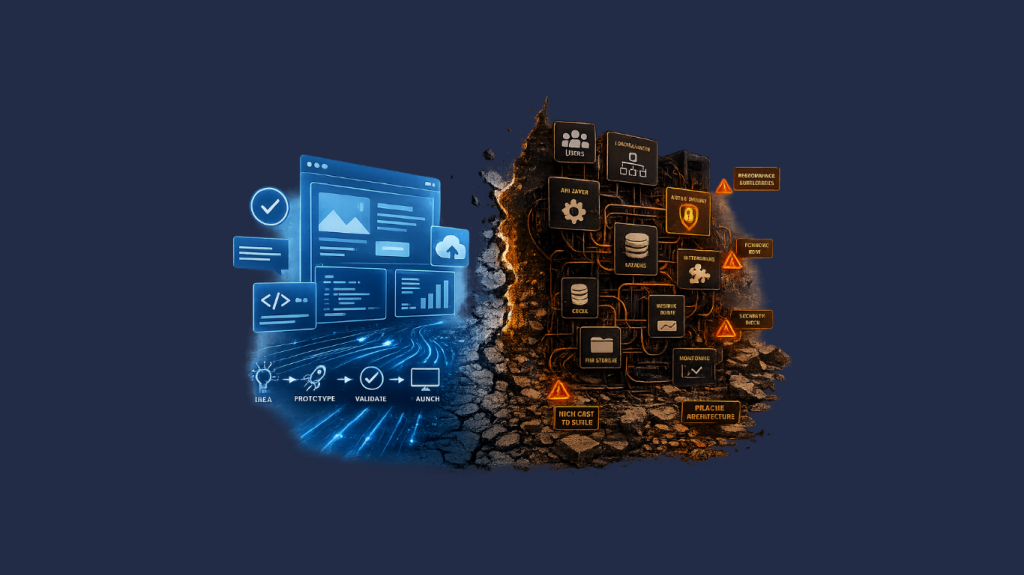
Not long ago, building a working application required weeks of planning, coding, and testing before anyone outside the development team saw meaningful progress. Today, it’s entirely possible to build a convincing prototype in a single afternoon. Give an AI coding assistant a well-written prompt, answer a few follow-up questions, and you’ll often end up with a login screen, database, API endpoints, and a polished user interface that looks ready to ship.
That’s an impressive leap in productivity, and it’s changing how organizations think about software development.
What’s interesting, though, is where the conversation usually goes next. Once stakeholders see a working application, they naturally start asking when it can be deployed. If the software behaves the way everyone expected, it’s easy to assume most of the hard work is already behind you.
In reality, that’s often where the most important work begins.
One pattern has become increasingly common as AI-assisted development matures. Teams produce functional software at remarkable speed, but they also skip many of the conversations that traditionally occur during application development. Questions about authorization, secret management, dependency governance, and security testing don’t disappear because AI generated the code. They become easier to overlook because the application already appears finished.
That’s the subtle risk with AI-generated software. Success is measured by how quickly something works, while security is measured by everything that doesn’t go wrong after it’s deployed.
This isn’t an argument against AI. Quite the opposite.
The organizations seeing the greatest benefit from AI are also investing in better engineering discipline. They’re using AI to eliminate repetitive work while strengthening the review process that determines whether an application is actually ready for production. The result isn’t slower development. It’s faster development without introducing business critical risks later on.
Security has always been part of software engineering. AI hasn’t changed that requirement—it has simply changed when and how often those security decisions need to be made.
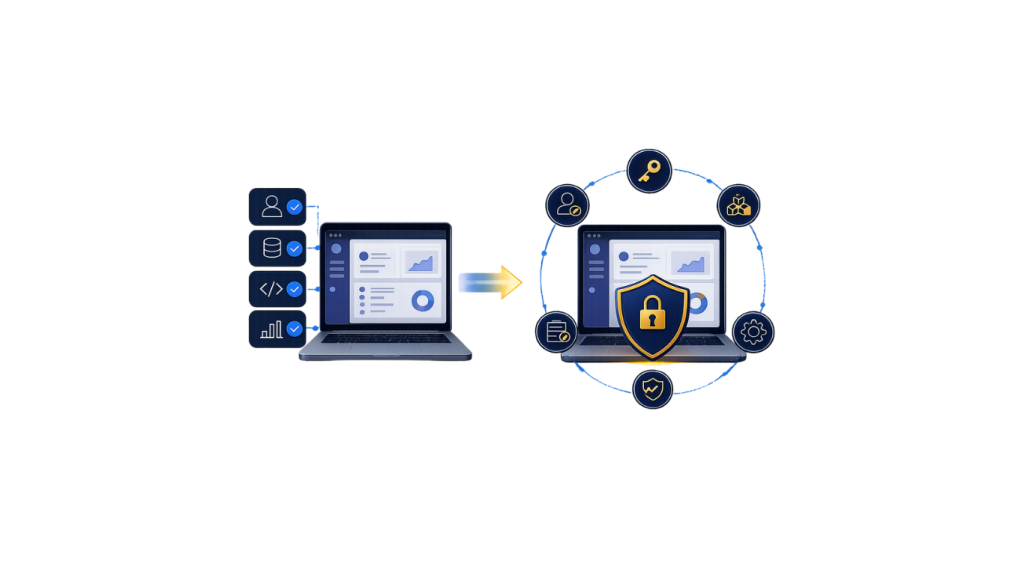
Why Security Reviews Matter Even More with AI-Generated Code
One misconception about AI-generated software is that it introduces an entirely new category of security problems. In most cases, it doesn’t.
The vulnerabilities showing up in AI-generated applications are the same ones security teams have been finding for years: exposed credentials, insufficient input validation, broken authorization rules, outdated dependencies, and inconsistent security testing.
What’s different is the pace.
When developers can generate thousands of lines of code in a fraction of the time it once took to write them manually, they also create far more opportunities for small mistakes to slip into production. AI doesn’t create those mistakes because it’s careless. It creates them because it’s focused on producing working software, not validating whether every implementation aligns with your organization’s security standards.
That’s an important distinction.
A generated application can authenticate users correctly while still allowing one customer to access another customer’s records. An integration can successfully connect to a cloud service even when using credentials that were accidentally committed during development. A file upload feature can perform perfectly during a demonstration while accepting file types that should never be allowed in production.
None of those problems prevents the application from working. That’s exactly what makes them dangerous.
The good news is that these issues are both predictable and preventable. Modern development teams already have access to tools that can automatically identify many of these risks, long before software reaches production. The key is to make security review part of the development workflow rather than treating it as the final checkpoint before deployment.
Security Review Focus Areas
Blind Spot #1: Hardcoded Secrets Don’t Stay Secret for Long
If there’s one mistake that consistently causes avoidable security incidents, it’s storing sensitive credentials directly in source code.
It’s rarely intentional.
A developer needs to test an external API, replace a placeholder value with a real key, confirm everything works, and move on to the next task. Later, someone commits the code without noticing the credential is still there. The application functions perfectly, so nothing raises immediate concern.
Weeks or even months can pass before anyone realizes that the repository contains production credentials.
By then, removing the key from the latest version of the code isn’t enough. Credentials committed to Git repositories become part of the project’s history. If the repository has been cloned, backed up, or made public at any point, those secrets should generally be treated as compromised and rotated immediately.
AI-generated projects make this easier to overlook because they frequently include sample configuration files, placeholder credentials, or integration examples designed to help developers get started quickly. During the rush to build a working prototype, temporary values often become permanent.
The better approach is to assume that application code should never know your secrets.
Environment variables, cloud secret managers, and secure deployment pipelines exist for exactly this reason. They allow applications to retrieve sensitive information when needed without exposing those credentials in the repository itself.
Automated scanning adds another layer of protection. A tool like Gitleaks can inspect commits for API keys, passwords, tokens, private certificates, and other sensitive values before they become part of your main branch. Developers still move quickly, but simple oversights are much less likely to become production incidents.
The lesson isn’t that AI generates insecure code. It’s that faster development leaves less time for developers to notice small mistakes on their own. Automated guardrails become increasingly valuable because they catch the issues that human reviewers can easily miss when code is being generated at high speed.
Blind Spot #2: Working Input Isn’t the Same as Safe Input
One of the easiest traps to fall into with AI-generated code is assuming that because a feature works during testing, it’s ready for production.
Most demonstrations follow the same pattern. Someone enters valid data into a form, clicks Submit, and everything behaves exactly as expected. The API responds, the database updates, and the user interface reflects the change. From a functionality standpoint, the feature is complete.
Production users, however, don’t always behave the way developers expect. Sometimes they make mistakes. Sometimes they paste data copied from another system. And sometimes they’re deliberately trying to find weaknesses.
That’s why input validation has always been a cornerstone of secure application development.
AI coding assistants are very good at building the “happy path.” They know how a registration form should work and how a search endpoint should respond to a normal request. What they don’t consistently do is account for every way an application might be misused.
Take file uploads as an example. An AI-generated application may successfully accept image files during testing because that’s exactly what the prompt described. But does it verify the actual file type? Does it limit file size? Does it prevent executable content from being uploaded with a misleading extension? Those are the kinds of questions that rarely show up in a demo, yet they matter tremendously in production.
The same applies to APIs. A generated endpoint might retrieve records efficiently, assuming that every request contains well-formed data. If unexpected values reach a database query, an operating system command, or another sensitive component without proper validation, you’ve created an opportunity for an attacker—not because AI wrote poor code, but because defensive programming was never part of the original conversation.
The encouraging part is that these issues are highly detectable.
Static analysis tools such as Semgrep examine source code for known insecure patterns and can identify situations where untrusted input reaches sensitive operations without appropriate safeguards. Rather than depending on manual code reviews to catch every edge case, developers receive immediate feedback while the code is still being written.
That’s exactly the kind of automation AI-assisted development needs. If software is being developed faster than ever before, security feedback needs to keep pace.
Blind Spot #3: Authentication Isn’t Enough Without Authorization
One of the most expensive security issues to fix is also one of the least obvious.
A user successfully logs into the application. They have the correct username and password, and multi-factor authentication is enabled. Everything appears secure.
Then someone changes a customer ID in the URL, and suddenly they’re looking at another organization’s data.
This isn’t an authentication problem. It’s an authorization problem.
The distinction matters because the two concepts are often confused, especially in applications generated with AI assistance. Authentication answers a simple question: Who is this user? Authorization answers a much harder question: What should this user actually be allowed to do?
That second question depends almost entirely on the business context.
AI doesn’t know that regional managers should only view customers assigned to their territory. It doesn’t know that healthcare providers should only access records for patients under their care. It doesn’t know that one client should never be able to retrieve another client’s invoices simply because both users are authenticated.
Those rules exist inside your business, not inside a language model.
This is one of the reasons production security can’t be evaluated solely by functionality. Every screen may load correctly. Every API request may return valid data. Yet the application can still expose sensitive information because ownership checks were never implemented.
These issues become even more difficult to identify as applications grow. A team might generate dozens of endpoints over several weeks, each functioning correctly on its own, while subtle authorization gaps accumulate across the system.
That’s why experienced engineering teams treat authorization as an architectural concern rather than an afterthought. Role-based access control, policy enforcement, object ownership checks, and consistent authorization middleware must be part of the application’s design from the beginning.
Security testing should reflect that philosophy as well. Instead of asking only, “Does this feature work?” teams should also ask, “What happens when the wrong user tries to access it?”
That simple shift in perspective uncovers many of the vulnerabilities that traditional functional testing never sees.
👋 Is your AI-generated application truly ready for production?
Curotec helps organizations evaluate AI-generated applications for security, architecture, and production readiness—so you can deploy with confidence, not assumptions.
Trusted by tech leaders at:



Blind Spot #4: AI Can Assemble Risky Dependencies Just as Quickly as Good Ones
One of the less obvious side effects of AI-assisted development is how quickly an application can accumulate dependencies.
Ask an AI coding assistant to build authentication, process PDFs, resize images, send email, generate reports, or integrate with a third-party service, and it will usually find a package that solves the problem. From a developer’s perspective, that’s incredibly convenient. Instead of spending hours evaluating libraries, much of the plumbing is assembled automatically.
The tradeoff is that convenience isn’t the same as governance.
Every dependency becomes part of your application’s security posture. Some libraries are actively maintained and regularly updated. Others haven’t received a meaningful update in years. A package may still work perfectly while containing known vulnerabilities or relying on unsupported components further down the dependency chain.
AI doesn’t evaluate those tradeoffs the way an experienced engineering team does. It recommends packages because they satisfy the prompt, not because they’ve been approved for your organization’s technology standards.
That doesn’t mean the recommendation is wrong. It simply means the recommendation shouldn’t be the final decision.
We’ve seen development teams discover dozens of unnecessary packages after reviewing an AI-generated prototype. Some were no longer maintained. Others duplicated functionality already available elsewhere in the application. None of them prevented the software from working, but every additional dependency increased the amount of software the team would need to monitor, update, and secure over time.
The question isn’t whether a package solves today’s problem. It’s whether you want to own that dependency for the next several years.
That’s why dependency management deserves a place in every AI-assisted development workflow. Automated Software Composition Analysis (SCA) tools continuously monitor third-party libraries for newly disclosed vulnerabilities, while services such as Dependabot can alert teams when security updates become available.
The earlier those dependencies are evaluated, the easier they are to replace. Waiting until production almost always makes the decision more expensive.
Blind Spot #5: Manual Security Reviews Don’t Scale
Perhaps the biggest misconception surrounding AI-generated software is that existing review processes will naturally keep up.
In practice, they rarely do.
If developers are producing two or three times as much code as they were a year ago, asking reviewers to inspect every line manually becomes increasingly unrealistic. Something has to change.
For many organizations, the answer isn’t hiring significantly larger security teams. It’s shifting more of the review process into automation.
That’s where modern DevSecOps practices become so valuable.
Instead of treating security as a milestone before deployment, leading engineering teams are moving those checks much earlier in the development lifecycle. Every commit, pull request, and build becomes an opportunity to identify issues before they spread through the application.
This approach benefits developers as much as security teams.
Finding an exposed credential minutes after it’s committed is far easier than discovering it after a release. Identifying an authorization issue during a pull request is much less disruptive than investigating a production incident weeks later. Early feedback shortens the correction cycle and allows teams to maintain development velocity without accumulating unnecessary risk.
AI has changed how quickly software can be written. It hasn’t changed how software becomes trustworthy.
That still depends on consistent engineering practices supported by automated guardrails.
Organizations that are succeeding with AI aren’t replacing experienced developers or security engineers. They’re giving those teams better tools. AI handles repetitive implementation work, while automated scanning, testing, and code review provide confidence that the generated code meets production standards.
That’s a much more sustainable model than expecting either developers or AI to catch every issue on their own.
Building Security Into an AI Development Workflow
Security works best when it becomes part of the development process instead of a separate project at the end.
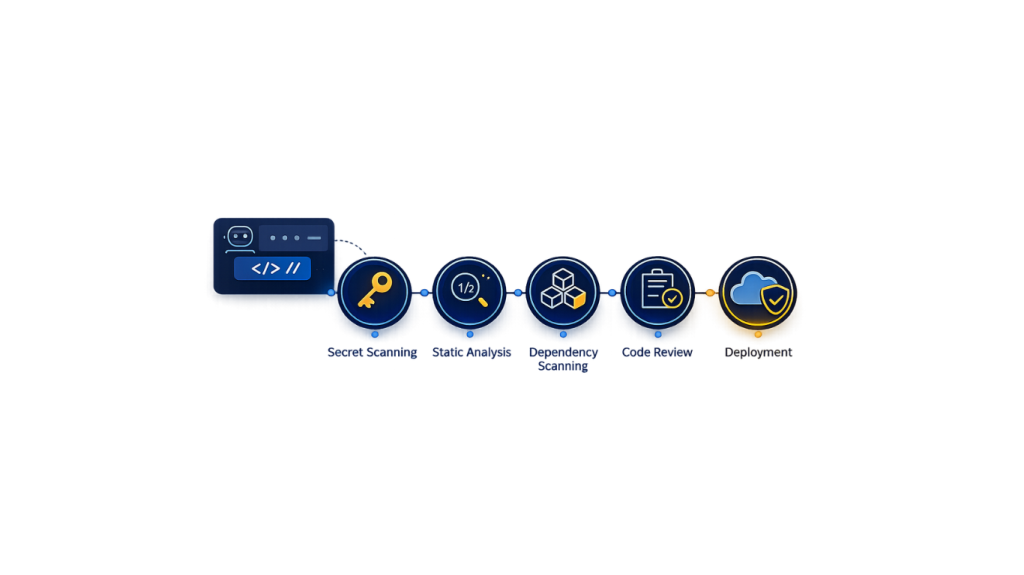
The most effective teams don’t rely on a single tool or a final review before deployment. They build multiple layers of protection into the software delivery pipeline, allowing different tools to identify different categories of risk as code moves toward production.
No single layer catches everything. Together, however, they dramatically reduce the likelihood that common security issues reach production.
Essential Security Checks for AI-Generated Applications
Semgrep and Gitleaks Solve Different Problems
It’s common to hear these tools mentioned together, but they address different risks.
One looks for insecure code. The other looks for sensitive information that never should have been committed in the first place.
Neither replaces the other.
Together, they provide complementary safeguards that help development teams move quickly without relying solely on manual reviews to catch preventable mistakes.
AI Doesn’t Replace Secure Engineering
There’s a temptation to view AI-generated code as something fundamentally different from traditional software development. In reality, it isn’t. The same engineering principles that have always produced secure, maintainable applications still apply.
What’s changed is the pace.
When software can be generated in hours instead of weeks, the review process has to evolve as well. Manual reviews alone can’t keep up with that volume. Automated guardrails, security scanning, and thoughtful architecture become even more valuable because they allow teams to move quickly without lowering their standards.
Organizations that succeed with AI won’t be the ones generating the most code. They’ll be the ones that build the best process around that code.
AI Is Changing Software Development—Not the Standards for Production
Every major advancement in software development has sparked the same conversation. Higher-level programming languages, open-source frameworks, low-code platforms, and cloud services all promised to speed up software development. Each one delivered on that promise, but none eliminated the need for sound engineering.
AI is no different.
The ability to generate working code in minutes is already reshaping how applications are designed and built. Development teams are moving faster, experimenting more freely, and delivering prototypes that would have taken weeks to produce just a short time ago. That’s a meaningful shift, and organizations that embrace AI thoughtfully will have a clear advantage.
But speed alone isn’t a competitive advantage. Deploying secure, reliable, and maintainable software is.
The organizations that will benefit most from AI won’t be the ones generating the most code. They’ll be the ones that pair AI-assisted development with disciplined engineering practices, automated security testing, and thoughtful architectural review. They’ll recognize that AI is an accelerator, not a substitute for experience or oversight.
Ultimately, the question isn’t whether AI-generated applications can be production-ready. They absolutely can.
The real question is whether the processes surrounding those applications are evolving as quickly as the technology itself.
When security reviews, automated testing, and governance are part of the development workflow rather than a final checkpoint, AI becomes far more than a productivity tool. It becomes a reliable way to deliver better software faster.
If your organization is building AI-generated applications and preparing them for production, contact Curotec to help you evaluate security, architecture, and long-term scalability—ensuring today’s prototype is ready to become tomorrow’s production system.