
For many organizations, the challenge of enterprise AI is no longer finding the right model. Modern large language models are already capable of generating content, analyzing information, and assisting employees in ways that would have seemed impossible just a few years ago.
The bigger challenge is getting those models access to the information that actually matters within enterprise systems and business workflows.
Customer records live in CRMs. Financial information sits inside ERP systems. Product documentation exists in knowledge bases. Operational data may be spread across databases, internal applications, cloud storage systems, and dozens of other tools. Without access to that information, even the most advanced AI model becomes little more than a sophisticated general-purpose assistant, which is why many organizations are investing in enterprise AI initiatives.
For the past several years, Retrieval-Augmented Generation (RAG) has been the preferred method for connecting AI systems to enterprise data. While RAG remains valuable for many use cases, organizations are increasingly discovering that building and maintaining large-scale retrieval pipelines introduces complexity, governance concerns, and security challenges that can slow AI adoption.
The Model Context Protocol (MCP) is emerging as an alternative approach. Rather than copying enterprise data into AI-specific infrastructure, MCP provides a standardized framework for securely connecting AI assistants directly to existing business systems while preserving the governance controls organizations already have in place.
As enterprises move from experimentation to production AI deployments, that distinction is becoming increasingly important.
The Real Obstacle to Enterprise AI Adoption
Many organizations have already proven that AI can deliver value. The problem is scaling that value safely.
Executives are no longer asking whether AI works. They are asking whether it can be trusted with sensitive business information.
Questions such as these frequently arise during enterprise AI initiatives:
- Can employees only access information they are authorized to see?
- Can customer data remain protected?
- Can the organization maintain compliance requirements?
- Can every AI interaction be audited?
- Can existing security policies remain intact?
These concerns often become the primary blockers to deployment.
The reality is that most enterprises have spent years building sophisticated governance frameworks around their data. Identity management systems, role-based permissions, audit logging, and compliance controls are already deeply embedded throughout the organization. Any AI initiative that bypasses or weakens those controls is unlikely to move beyond the pilot stage.
This is where traditional retrieval architectures can begin to create friction.
The Hidden Governance Challenges of RAG
Retrieval-Augmented Generation has become one of the most widely adopted techniques for enterprise AI. The concept is straightforward. Rather than relying solely on a model’s training data, organizations retrieve relevant information from proprietary sources and provide it to the model during inference.
In practice, however, implementing RAG often requires substantial supporting infrastructure.
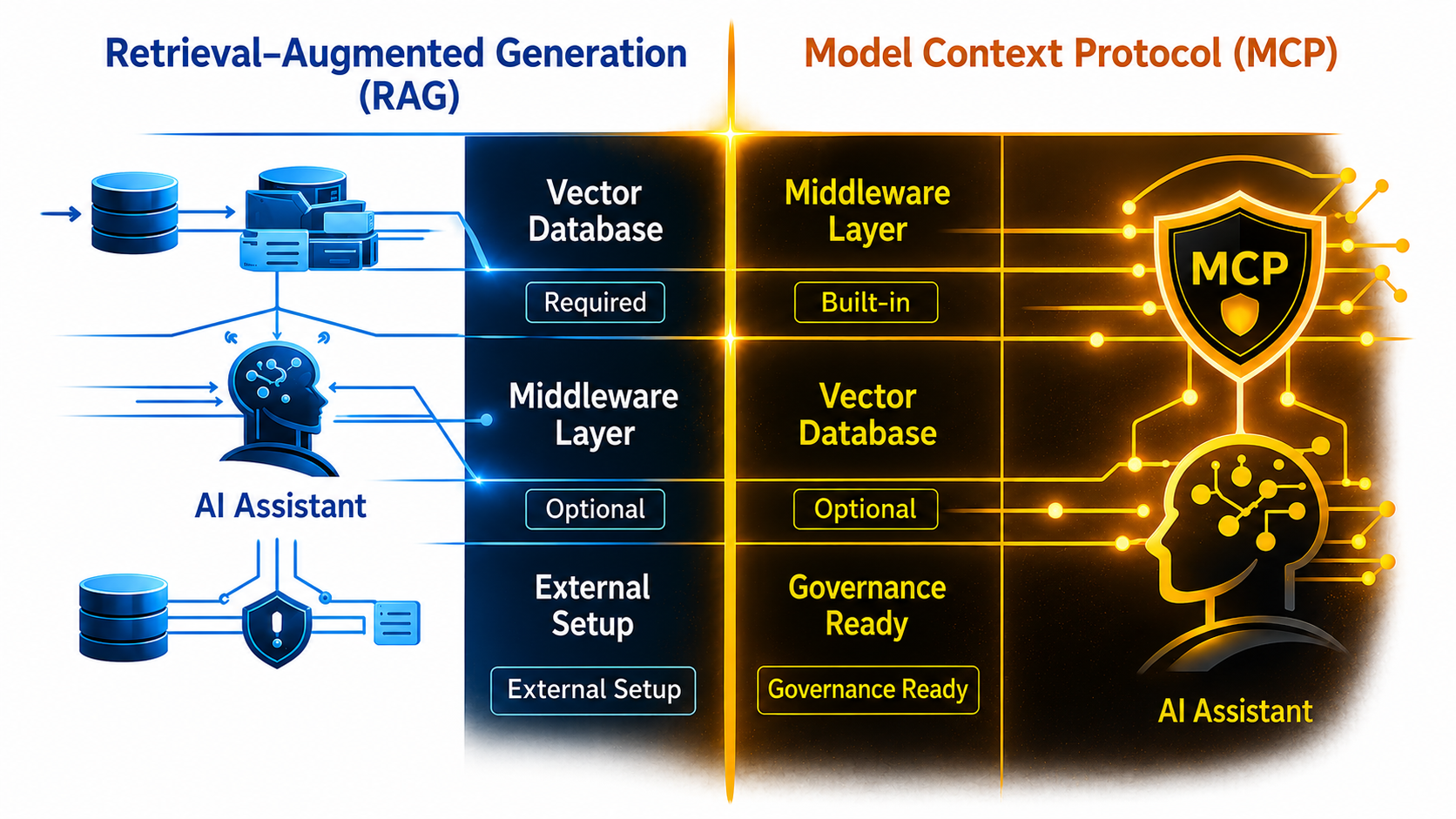
Enterprise data must typically be extracted from source systems, transformed into a usable format, converted into embeddings, and stored in a vector database. Retrieval services must then locate relevant information and inject it into prompts before the model generates a response.
While this approach works well for many scenarios, it introduces several governance challenges.
First, organizations often create additional copies of sensitive data. Information that originally existed in a CRM, database, or document repository may now also exist in vector databases, indexing services, and processing pipelines.
Second, permission management becomes significantly more complicated. Existing access controls must either be replicated or synchronized across multiple systems. Ensuring that a user’s permissions remain consistent across every layer of the architecture can quickly become difficult.
Third, organizations must continuously maintain synchronization between source systems and retrieval indexes. When data changes, permissions change, or records are removed, those updates must be reflected throughout the entire pipeline.
As AI deployments grow, these challenges frequently become operational burdens.
Enter the Model Context Protocol
The Model Context Protocol takes a fundamentally different approach.
Instead of building extensive retrieval pipelines that move information into AI-specific storage systems, MCP provides a standard method for AI applications to communicate directly with external systems.
Think of MCP as a universal interface between AI assistants and enterprise software.
An MCP server can expose specific capabilities from systems such as:
- Salesforce
- HubSpot
- ServiceNow
- Internal databases
- Document repositories
- ERP platforms
- Custom business applications
When an AI assistant needs information, it can request it from the MCP server rather than searching a separate retrieval database.
This may seem like a subtle architectural difference, but the governance implications are significant.
👋 How are you planning to securely connect AI to your enterprise data?
Whether you’re evaluating MCP, RAG, or a hybrid approach, Curotec can help you design the right architecture.
Trusted by tech leaders at:



Keeping Governance Where It Belongs
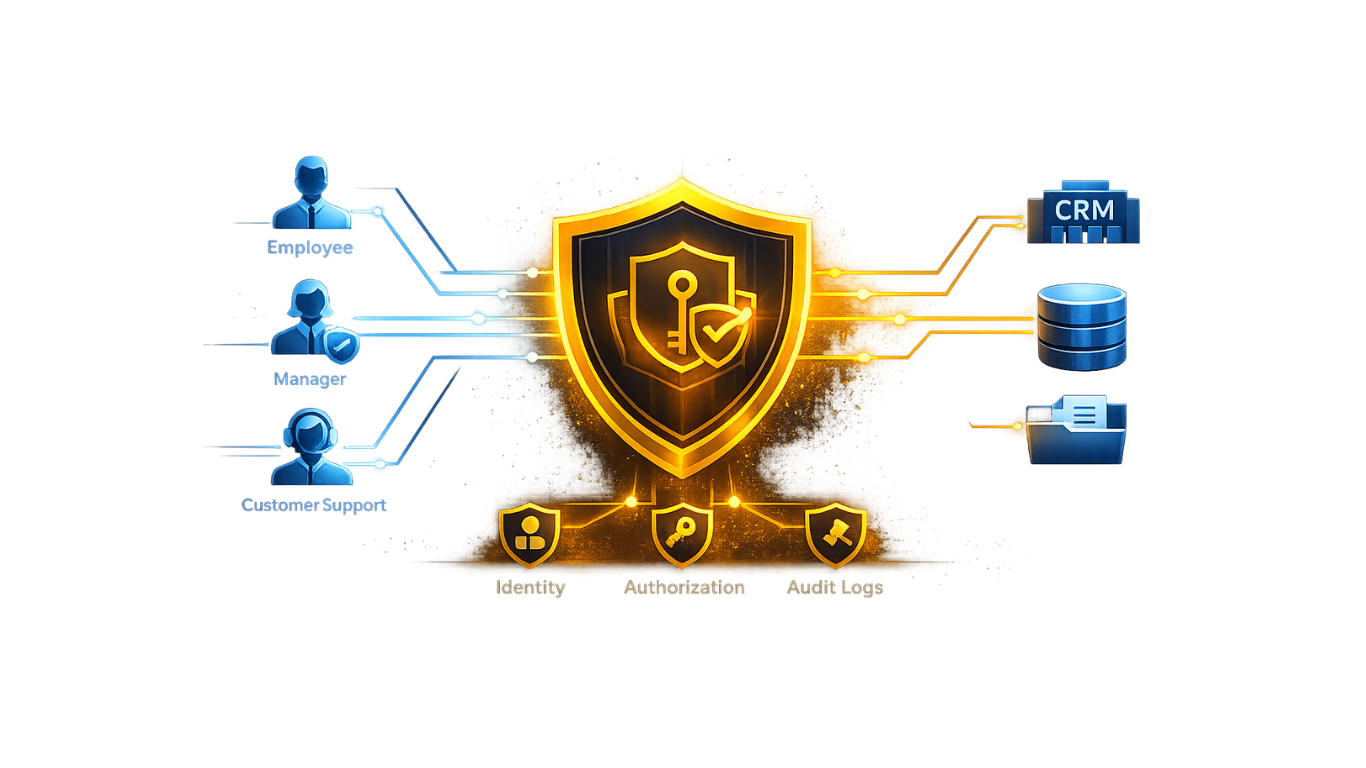
One of MCP’s greatest advantages is that it enables organizations to keep authorization controls close to the data source.
Consider a customer service representative using an AI assistant to access account information.
In a traditional retrieval architecture, permissions may need to be replicated into a vector database and synchronized with the CRM. Any mismatch creates potential risk.
With MCP, the request can flow directly through systems that already understand the user’s permissions.
If the representative has access to a CRM account, the AI assistant can retrieve the information.
If they do not have access, the request is denied.
The AI never becomes a shortcut around existing governance policies.
This alignment with established security practices is one reason many enterprises are viewing MCP as a promising foundation for production AI systems.
Real-Time Data Without Complex Synchronization
Another challenge facing many RAG implementations is data freshness.
Business information changes constantly. Customer records are updated. Inventory levels fluctuate. Support tickets are created and resolved. Financial information changes throughout the day.
Maintaining accurate retrieval indexes requires ongoing synchronization efforts.
MCP reduces this burden by enabling direct access to source systems.
Rather than relying on information that may have been indexed hours or days earlier, AI assistants can retrieve current information directly from the system of record.
For organizations making operational decisions, that distinction matters.
An AI assistant that accesses real-time customer, inventory, or support information is often more valuable than one relying on periodically refreshed data.
Security Must Remain the Priority
Of course, directly connecting AI systems to enterprise applications does not automatically make an architecture secure.
Successful MCP implementations still require disciplined governance practices.
Identity must flow through every request. The system should always know who initiated the interaction and what permissions they possess.
Organizations should embrace least-privilege principles by exposing only the capabilities required for approved business workflows. An AI assistant rarely needs unrestricted access to an entire database when it only needs access to a limited set of business functions.
Comprehensive audit logging is equally important. Every interaction should be traceable so organizations can understand what information was requested, who requested it, and how the system responded.
These principles are not unique to AI. They are established security best practices applied to a new generation of applications.
MCP Is Not Replacing RAG
Despite the growing excitement surrounding MCP, it would be a mistake to view it as a complete replacement for RAG.
The two architectures solve different problems.
RAG remains extremely valuable for semantic search across large document collections, historical knowledge repositories, and unstructured content. It excels when organizations need to retrieve relevant information from large volumes of text.
MCP, on the other hand, excels at providing governed access to operational systems and structured enterprise data.
In many organizations, the future architecture will likely involve both approaches working together.
A customer support assistant might use RAG to search documentation while simultaneously using MCP to retrieve live customer account information from a CRM. The combination provides both knowledge retrieval and real-time business context.
Rather than competing technologies, MCP and RAG are increasingly becoming complementary components of modern AI architectures.
The Bigger Shift Toward Governed AI
The rise of MCP reflects a broader trend in enterprise AI.
Early AI conversations focused heavily on model capabilities. Today, the discussion has shifted toward governance, security, and operational trust.
Organizations are asking different questions than they were a year ago.
How do we maintain access controls?
How do we preserve compliance requirements?
How do we prevent unauthorized data exposure?
How do we create auditability?
How do we scale AI responsibly?
These questions are ultimately more important than model benchmarks because they determine whether AI can be deployed across the enterprise at all.
MCP addresses many of these concerns by allowing organizations to connect AI systems to business data without abandoning the governance frameworks they have already spent years developing.
That is one of the most important developments in enterprise AI adoption over the next several years.
How Curotec Helps Organizations Build Secure Enterprise AI
Connecting AI to enterprise systems requires more than simply selecting a model or deploying a chatbot. It requires thoughtful architecture, governance planning, security controls, and integration expertise.
Whether your organization is evaluating MCP, building a RAG solution, or exploring a hybrid architecture, the goal should remain the same: providing AI with access to business data while maintaining the security and governance standards your organization depends on.
Curotec helps organizations design and build enterprise AI solutions that integrate securely with existing systems, preserve governance controls, and create long-term business value.
Ready to connect AI to your enterprise data without sacrificing security or compliance? Contact Curotec to discuss the architecture that best fits your organization.