
AI has moved past the experimental phase.
What’s changing now isn’t just model quality. It’s how AI systems interact with real applications. Instead of generating answers in isolation, they’re now operating within workflows, pulling live data, and triggering actions.
That shift introduces a challenge most teams run into quickly. How do you give an AI agent access to your application without stitching together brittle APIs and prompts?
This is where Model Context Protocol (MCP) comes in. More importantly, it’s why Laravel’s early support for MCP carries more weight than it might seem at first glance.
Why MCP Is Showing Up Now
For the past couple of years, most AI integrations have been held together with prompts and custom API layers. That approach works for simple use cases, but it breaks down as soon as systems need consistency, auditability, or real workflow integration.
At the same time, AI agents are becoming more capable. They’re expected to:
- Retrieve live data
- Take actions
- Operate across systems
That combination—more capable agents and more complex expectations—is what makes MCP relevant right now.
What Model Context Protocol Actually Does
At a high level, MCP defines how AI systems request and receive context from an application. That’s still abstract on its own. It becomes clearer when you compare it to how most teams are handling AI integrations today.
In many cases, the pattern still looks like this:
- A prompt is constructed manually
- Relevant data is injected into that prompt
- The model responds with limited awareness of the system behind it
It works, but only up to a point. As systems grow more complex, they start to break down.
MCP changes that model entirely.
Instead of forcing context into prompts, it exposes structured capabilities that an agent can interact with directly.
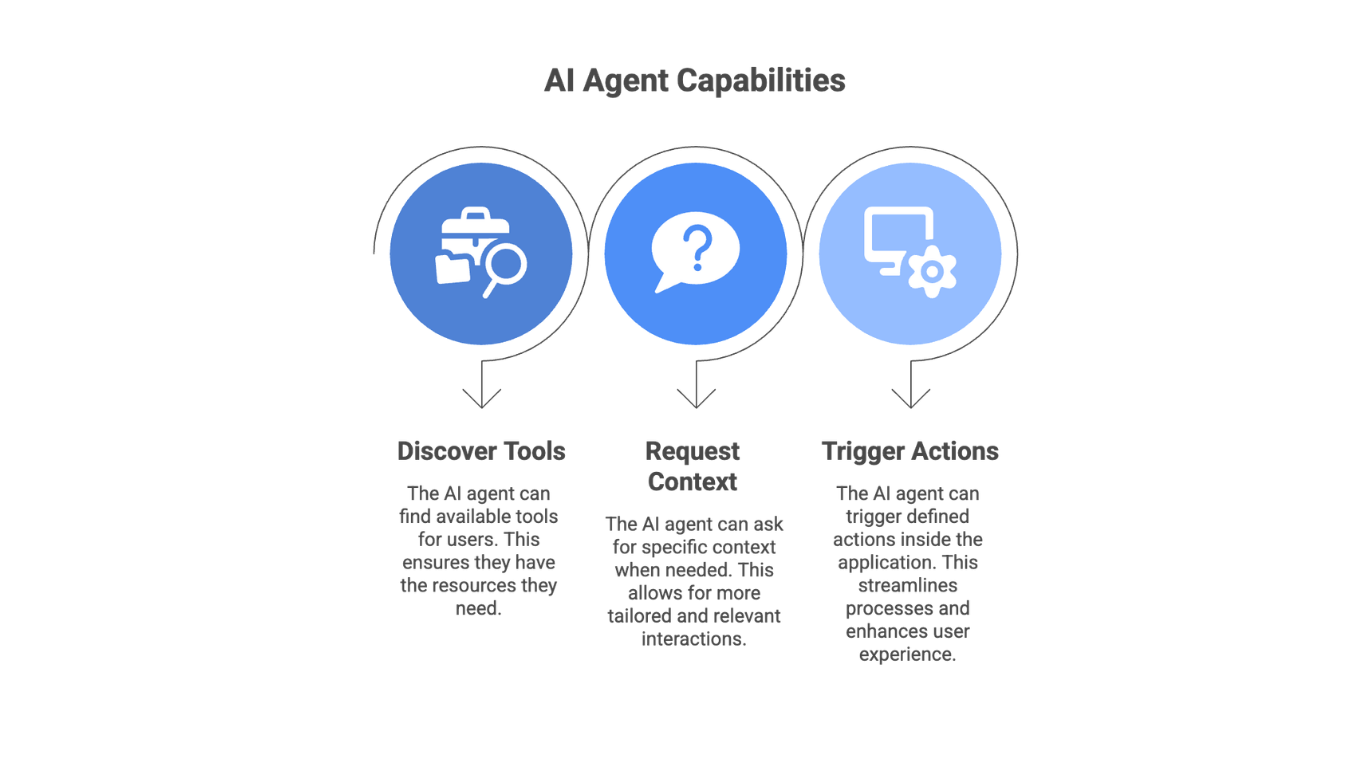
That means an AI agent can:
- Discover available tools
- Request specific context when needed
- Trigger defined actions inside the application
The shift here is subtle but important.
You’re no longer guessing what the model should know. You’re defining what it’s allowed to access and how it can interact with it.
That’s what makes MCP reliable at scale—and why prompt-based approaches tend to fall apart as systems grow.
Why MCP Matters for Laravel Applications
Laravel applications already contain the exact things AI agents need:
- Business logic
- Data relationships
- Defined workflows
- Permission boundaries
The issue has never been capability. It’s been the lack of a clean way to expose that capability.
MCP turns a Laravel application into something an AI agent can interact with in a structured, predictable way—without bypassing the rules of the system.
That opens the door to things that are difficult to do reliably today:
- Internal pilots that operate on real application data
- AI-driven workflows that trigger jobs, not just generate text
- Automation that respects existing validation and permissions
- AI-assisted decision layers that combine operational data with recommendations
The distinction is simple but important.
MCP doesn’t bolt AI onto Laravel. It allows AI to operate through Laravel.
If you’re already thinking about how AI fits into your product or internal tools, it’s worth grounding that in a clear implementation approach, such as your AI/ML development strategy.
How MCP Fits Into Laravel’s Direction
Laravel didn’t suddenly become relevant to AI. It’s been moving in this direction for years, just not under that label.
Think about what Laravel has added over time:
- Queues for background processing
- Events for system communication
- Broadcasting for real-time updates
- APIs as first-class citizens
Each step made it easier to build systems that behave dynamically rather than respond to requests.
MCP fits naturally into that progression.
It extends Laravel’s role beyond an application framework into something closer to an orchestration layer. This system not only handles requests but also exposes its capabilities in a structured way to other systems, including AI agents.
What a Laravel MCP Server Looks Like
“MCP server” sounds heavier than it actually is. In practice, a Laravel MCP server is just a thin layer that sits alongside your application and exposes a controlled set of capabilities to an AI agent.
It typically defines three things:
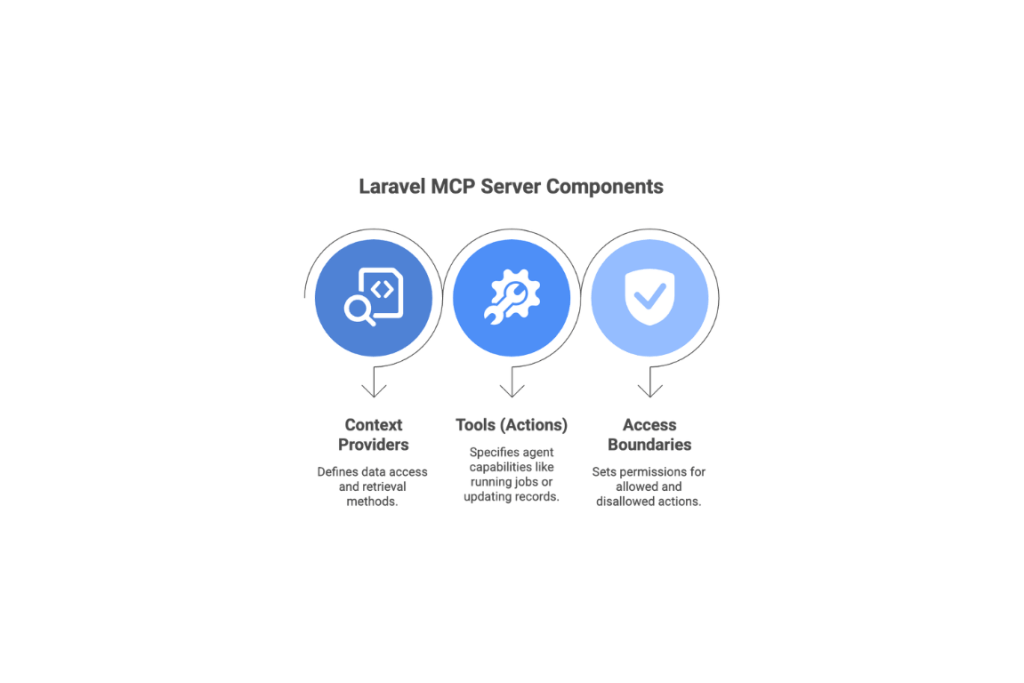
- Context Providers: What data can be accessed, and how it’s retrieved
- Tools (Actions): What the agent is allowed to do—run a job, update a record, trigger a workflow
- Access Boundaries: What’s allowed, what isn’t, and under what conditions
The important shift is how those capabilities are exposed. You’re not giving an agent raw access to your database or generic endpoints. You’re defining specific, intentional operations.
Not “query the database”.
Rather, “retrieve customer order history”.
In practice, that often looks like:
- getCustomerOrders(customerId)
- createRefund(orderId, reason)
- checkOrderStatus(orderId)
Each of these maps directly to Laravel services, not database queries. That keeps business logic intact and prevents agents from operating outside defined workflows.
This is where structure starts to matter.
If your service layer is clean and well-defined, MCP fits naturally. If it isn’t, that becomes obvious quickly. MCP tends to expose those gaps rather than hide them.
How MCP Changes the Architecture
It helps to think of MCP as a translation layer between an AI agent and your application.
In practice, this layer builds on the same patterns used in modern application development services, where logic is separated into clean, reusable services.
A typical flow looks like this:
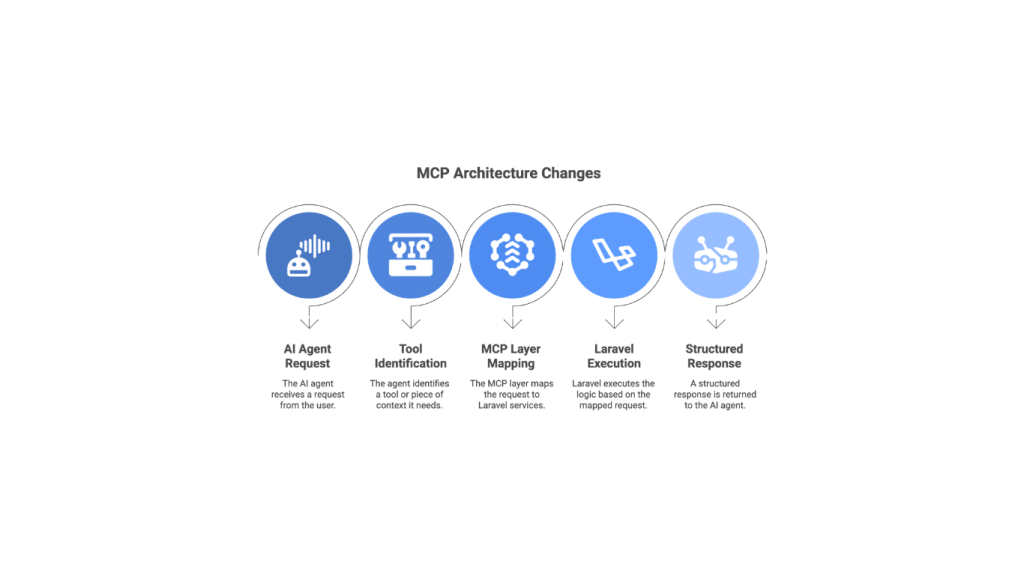
- An AI agent receives a request
- It identifies a tool or piece of context it needs
- The MCP layer maps the request to Laravel services
- Laravel executes the logic
- A structured response is returned
Laravel stays in control throughout.
The agent doesn’t bypass your application. It works through it.
That means:
- Validation still runs
- Permissions still apply
- Business rules are still enforced
You’re not handing over the keys. You’re defining the doors.
It also means architectural weaknesses become harder to ignore. MCP doesn’t hide them—it surfaces them.
👋 Looking to safely connect AI agents to your Laravel application?
Curotec helps design MCP-based architectures that expose the right data and actions without compromising security or control.
Trusted by tech leaders at:



Security and Control Considerations
Any time AI is introduced into a system, the first concern isn’t capability—it’s control.
MCP can improve that situation, but only if it’s implemented deliberately.
Because tools and context are explicitly defined, you can:
- Scope access to specific actions
- Enforce authentication at the MCP layer
- Log and audit interactions
- Prevent unintended data exposure
In many ways, this mirrors how well-designed APIs behave. The difference is that the consumer is now an AI agent rather than a frontend or another service.
If your team is already thinking about governance or compliance, this is where architecture decisions start to matter. It’s also where strong data engineering practices become critical to keep systems secure and observable.
Where MCP Makes Immediate Business Impact
This is where the conversation moves out of theory.
MCP becomes useful when AI needs to do more than generate responses.
Some practical examples:
- Internal tools where AI can retrieve and act on operational data
- Customer support systems that go beyond scripted responses
- Workflow automation that triggers real processes, not just suggestions
- Developer-facing tools embedded directly into platforms
The pattern is consistent.
AI becomes part of the system, not just an interface to it.
When MCP Might Be Overkill
Not every application needs this.
If your system is:
- Small and relatively static
- Mostly content-driven
- Already well-served by simple API calls
Then, MCP may introduce more complexity than value.
It becomes relevant when:
- Workflows matter
- Data relationships are meaningful
- Actions need to be triggered safely
In other words, when your application behaves like a system, not just a site.
Getting Started with MCP in Laravel
If you’re evaluating MCP for the first time, the goal isn’t to build a full system immediately.
Start smaller than you think.
A typical starting point looks like this:
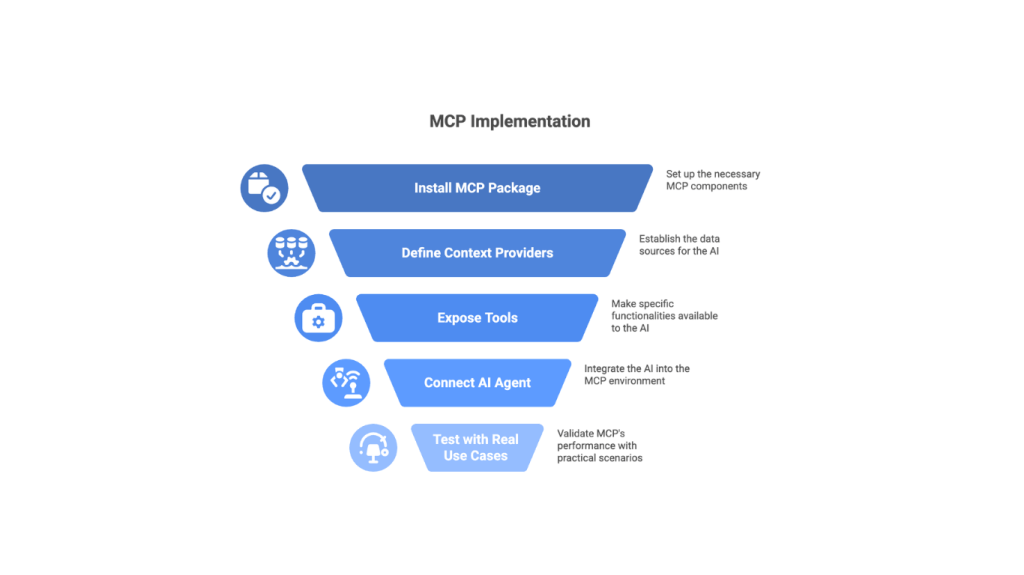
- Install the Laravel MCP package
- Define a limited set of context providers
- Expose a small number of tools
- Connect an AI agent in a controlled environment
- Test with real use cases, not synthetic ones
Under the hood, this usually means mapping MCP tools to Laravel service classes, jobs, or controllers rather than exposing raw models directly.
Teams that have already invested in structured backend systems through custom software development tend to move faster here.
The teams that get the most value from MCP treat it as an incremental capability rather than a one-time implementation.
Where This Is Heading
MCP isn’t just another integration pattern.
It reflects a broader shift in how applications are designed.
Instead of building systems that humans operate while AI assists from the outside, we’re moving toward systems where:
- AI can navigate application capabilities directly
- Workflows are partially delegated
- Context is structured rather than improvised
Laravel’s early move here matters because it lowers the barrier to building these kinds of systems in a practical, implementable way.
There’s a lot of noise around AI right now, but most of it focuses on what models can do.
MCP points to something more foundational. It’s about making your application usable by AI in a controlled, structured way.
For Laravel teams, that’s a meaningful shift.
If you’re starting to think about how AI agents could interact with your application—not just sit beside it—it’s worth getting ahead of this early. Curotec helps teams do exactly that through its AI and software development services, designing MCP-ready architectures that expose the right capabilities without introducing unnecessary complexity. Contact Curotec to start the conversation.