
The Real Question Isn’t Speed–It’s Responsibility
If you’re a startup experimenting with a landing page, this probably isn’t for you.
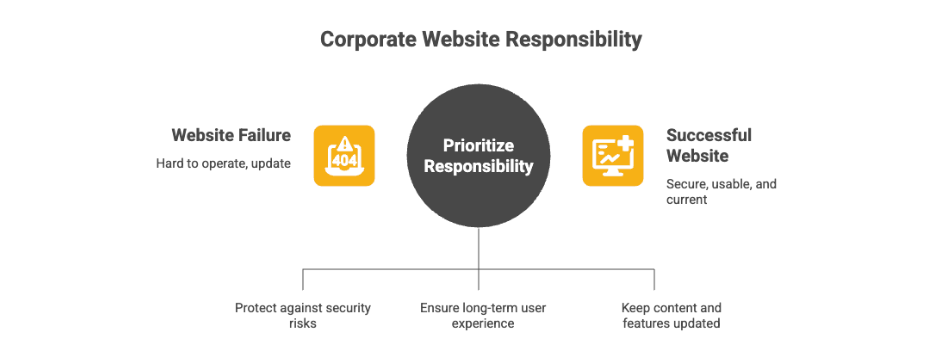
This article is written for corporate digital teams—engineering leaders, marketing teams, product managers, and IT stakeholders—who are responsible for a website that must remain current, secure, and usable long after the launch announcement fades.
Right now, it’s easier than ever to get a website live. AI-assisted tooling and modern JavaScript frameworks have collapsed build timelines. If your team already works in Next.js, platforms like Replit let you quickly scaffold and deploy something, sometimes in a matter of days.
That speed is real. And in the proper context, it’s valuable.
The problem is that corporate websites rarely fail because they took too long to launch. They fail because they become hard to operate, hard to update, or quietly risky once they’re in production.
That’s where the real tradeoffs between vibe-coded Next.js mature CMS frameworks like WordPress show up.
Speed to Launch Is Easy. Operating the Site Is Not
Vibe coding shines at the beginning. You can move fast without committing to much upfront structure. Layouts, routing, and components fall into place quickly, often with AI making decisions on your behalf.
For product teams, that’s often precisely what you want.
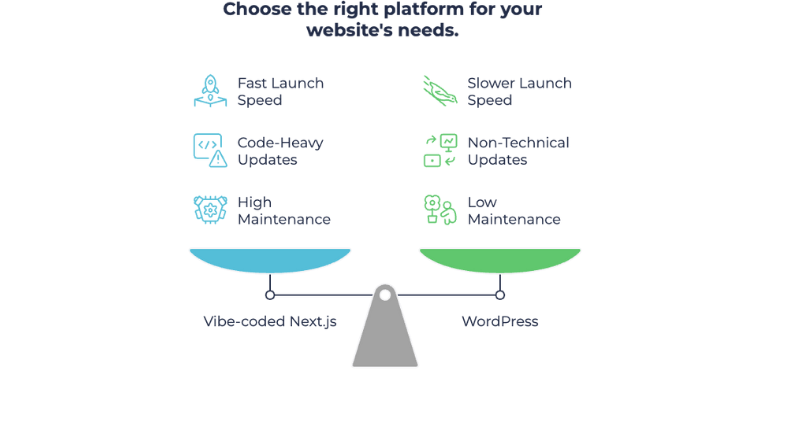
Corporate websites behave differently. They don’t stabilize after launch. They change constantly.
In a typical enterprise environment, the site gets touched for reasons that have nothing to do with engineering:
- Marketing updates homepage messaging for a new campaign
- Legal requests a wording change to meet compliance requirements
- HR adds or removes leadership bios
- Product marketing reshuffles navigation to reflect a new offering
These are routine changes. And they happen all the time.
When those changes require developer involvement, they slow down—not because engineers are slow, but because those tasks compete with work that’s always deemed more important. In practice, “just a small update” often waits behind product roadmap items.
With a vibe-coded Next.js site, even modest changes usually involve code edits, pull requests, builds, and redeployments. Over time, that friction adds up.
WordPress was built around this reality. It assumes that non-technical users will make frequent updates. Marketing teams can change content and layouts without waiting on engineering, while developers focus on structure, performance, and integrations.
The difference isn’t apparent on day one. It becomes evident by month six
Ownership Is the Part Teams Underestimate
Most platform decisions fail not because of technology, but because of ownership.
In many organizations, a Next.js site launches under engineering ownership and tends to stay there. Early on, this works well—changes are fast, and everyone is paying attention. Over time, as priorities shift to product delivery and other initiatives, marketing requests begin to queue up behind engineering work. Small updates are rarely urgent enough to compete, and content backlogs quietly grow. This pattern shows up consistently in enterprise digital teams, even when the original platform choice was made with the best intentions.
Eventually, people stop asking for changes and work around the site instead.
This pattern shows up repeatedly in mid-size and large organizations. It’s not a tooling failure—it’s a mismatch between who owns the platform and who needs to use it day to day.
WordPress distributes ownership more realistically. Marketing teams manage content and layouts within guardrails. IT and engineering retain control over security, performance, and integrations. No single group becomes a permanent bottleneck.
That division of responsibility isn’t elegant. It’s just practical.
Security: Where Convenience Quietly Becomes Risk
This is where vibe coding deserves more scrutiny.
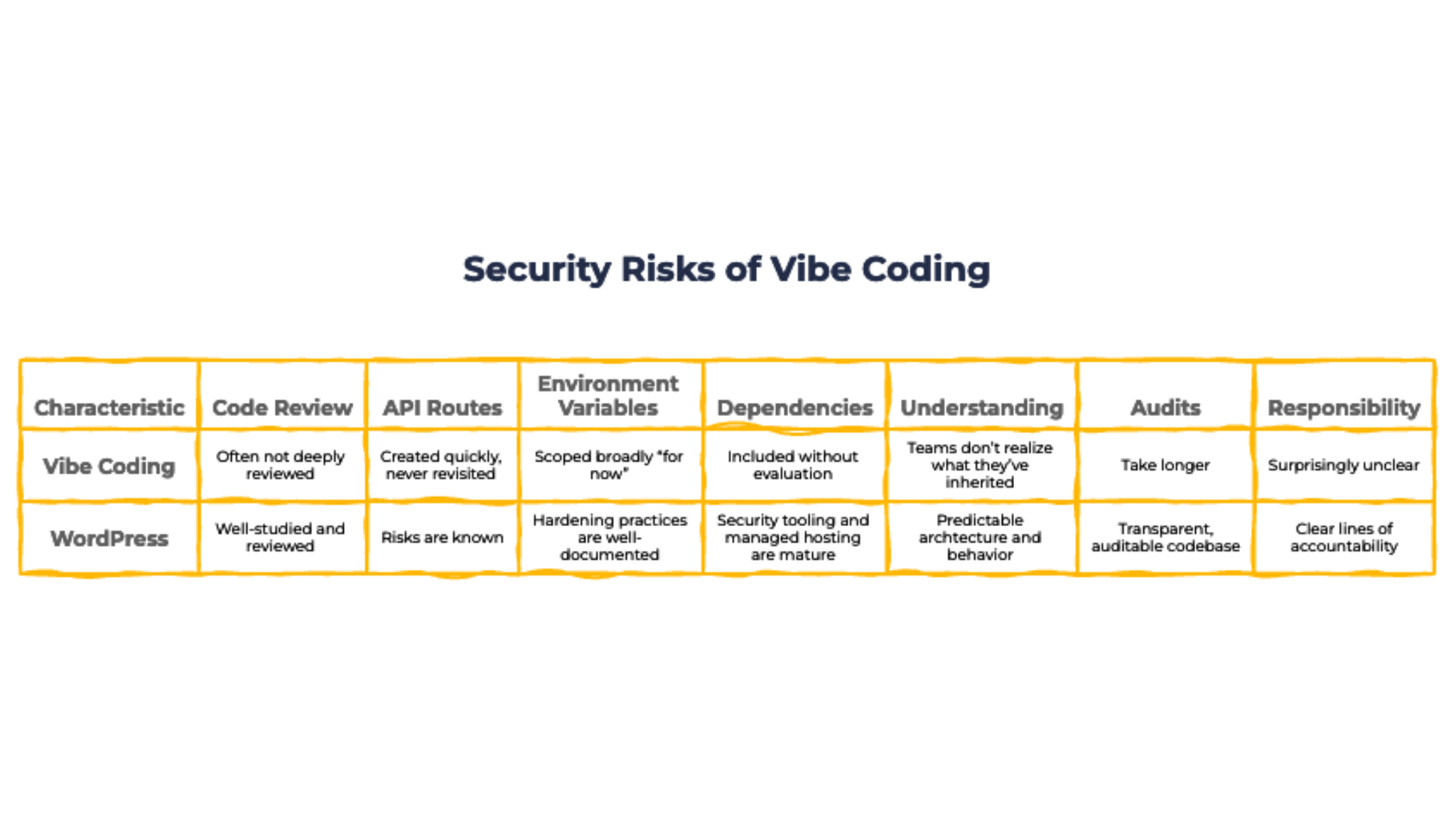
AI-generated code often works well enough to ship, which means it doesn’t always get deeply reviewed. In real corporate environments, that leads to things like:
- API routes created quickly and never revisited
- Environment variables scoped broadly “for now”
- Dependencies included because a tool suggested them, not because someone evaluated them
If you’ve ever been through a security review, this should sound familiar.
Most breaches don’t start with sophisticated attacks. They begin with misconfigurations, assumptions, and pieces of the system that no one fully understands. Platform abstraction makes this worse. When infrastructure and runtime behavior are hidden behind convenience layers, fewer people can clearly explain what’s in production.
Audits take longer. Compliance questions get harder to answer. And when something breaks, responsibility can be surprisingly unclear.
WordPress has a large attack surface, but it’s also one of the most studied platforms on the web. Its risks are known. Hardening practices are well documented. Security tooling and managed hosting options are mature.
The risk with vibe-coded systems isn’t that they’re reckless—it’s that teams often don’t realize what they’ve inherited.
Maintenance Is Where the Cost Shows Up
Early on, maintenance feels theoretical.
Later, it isn’t.
Next.js evolves quickly. Framework updates, breaking changes, and shifting conventions are part of the ecosystem. Keeping a site current often means refactoring—not because it’s broken, but because the surrounding tooling moved on.
That work usually requires senior engineering time, which is both expensive and scarce.
WordPress maintenance is less dramatic. Core and plugin updates follow predictable cycles. Most content and layout changes don’t require developers at all. Costs tend to grow gradually rather than spike unexpectedly.
For corporate websites expected to live for years, that predictability matters more than early speed.
👋 Not sure which website platform is right for your team?
Curotec works with engineering, marketing, and IT leaders to assess platform tradeoffs and design website architectures that are easy to launch and sustainable to manage over time.
Trusted by tech leaders at:



The Question Teams Should Actually Ask
Vibe coding is useful. In the right context, it’s a real accelerator.
But corporate websites aren’t experiments. They’re operational systems that need to be updated, secured, and governed by people who didn’t build them and who won’t always have on-demand engineering support.
So the real question isn’t how fast you can get something live. It’s who has to maintain it when priorities shift, teams change, and the site keeps evolving. For many organizations, WordPress remains the better answer—not because it’s exciting, but because it aligns with how work actually happens after launch.
If you’re weighing Next.js, WordPress, or another platform for a corporate website, the right decision usually isn’t about tools—it’s about long-term ownership, security, and how your teams actually work.
Curotec helps organizations evaluate website platforms and architectures with those realities in mind. From modern JavaScript frameworks to WordPress and hybrid approaches, we work with engineering, marketing, and IT teams to design solutions that are fast to launch and sustainable to operate.
Contact Curotec to discuss a website platform decision grounded in how your teams work today and how the site will be managed long after launch.