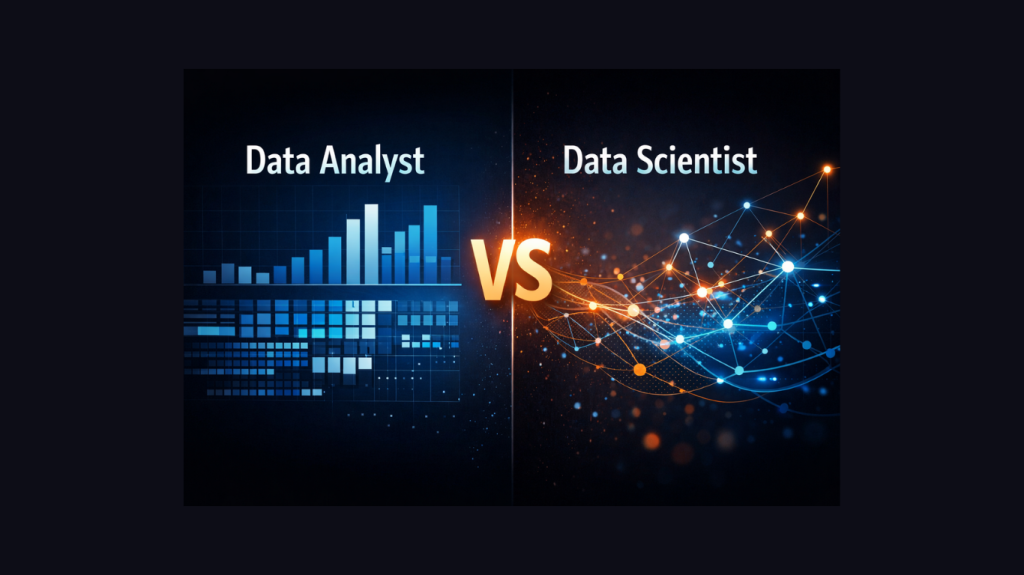
As more companies invest in data, the real question isn’t whether to hire for data expertise—it’s who to hire first. The terms data analyst and data scientist are often used interchangeably, even though they serve very different purposes in practice. Choosing the wrong role too early can slow teams down, inflate costs, and leave decision-makers frustrated when results don’t match expectations.
In many cases, the issue isn’t talent alone. It’s whether existing systems are ready to support meaningful analysis or prediction in the first place. Without strong foundations, even the right hire can struggle to deliver value, which is why decisions about data roles are often tied to broader efforts around modernizing existing systems.
This post breaks down when a data analyst is the right hire, when a data scientist actually makes sense, and why many teams get this decision backwards.
What a Data Analyst Is Hired to Do
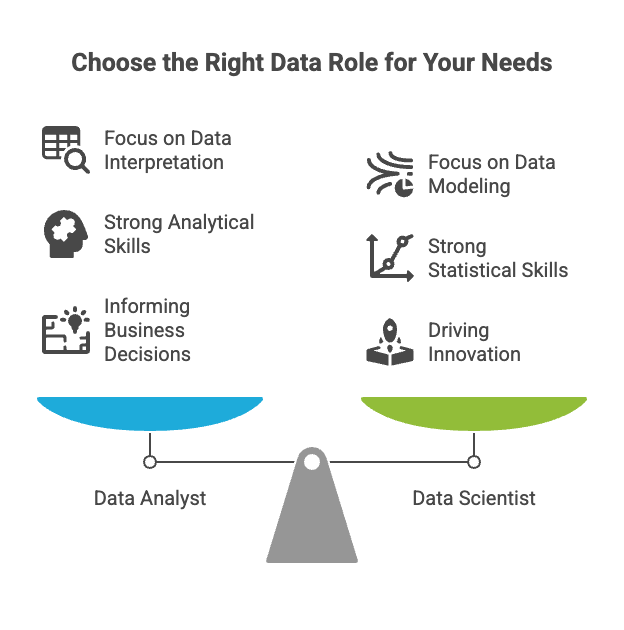
A data analyst’s job is to help the business understand what is already happening. They work primarily with existing, structured data and focus on clarity, accuracy, and communication.
Most analysts spend their time answering questions like:
- How did performance change this month compared to last month?
- Which channels or features are driving results
- Where numbers don’t align and why
Their work often lives close to operations and leadership. Dashboards, reports, and ad-hoc analysis are not side tasks—they are the product.
A strong data analyst brings order to messy data, validates assumptions, and translates numbers into insight that non-technical teams can actually use.
What a Data Scientist Is Hired to Do
A data scientist is typically brought in when a company wants to predict, automate, or optimize outcomes at scale. Rather than summarizing the past, their work focuses on modeling the future.
This might include:
- Forecasting demand or churn
- Building recommendation systems
- Detecting anomalies or patterns that aren’t obvious
- Training models that influence product behavior
Data scientists work with larger, more complex datasets and often rely on experimentation. Their output is less likely to be a dashboard and more likely to be a model, algorithm, or internal system that other software depends on.
Because of this, data science work usually requires stronger foundations in data quality, infrastructure, and engineering support.
The Core Difference That Actually Matters
The most important distinction isn’t tools, math skills, or job seniority.
Its intent.
A data analyst helps you understand what’s happening so humans can make better decisions.
A data scientist helps systems make decisions automatically or predict what will happen next.
When teams confuse those goals, problems start.
Data Analyst. vs Data Scientist Side-by-Side Comparison
👋 Not sure which data role your team needs?
Share a few details about your goals and current data setup. We’ll help you determine the right next step.
Trusted by tech leaders at:



When a Data Analyst Is the Right First Hire
Most organizations should start with a data analyst, especially if:
- Reporting is inconsistent or unreliable
- Teams don’t trust their numbers
- Leadership spends too much time debating metrics
- Data exists, but isn’t utilized effectively
Without clean, well-understood data, advanced modeling rarely delivers value. Analysts often do the foundational work—cleaning, structuring, and contextualizing data—that enables future data science.
If you’re still asking, “What’s going on in our business?” you likely need an analyst, not a scientist.
When a Data Scientist Makes Sense
A data scientist becomes valuable once:
- Core metrics are stable and trusted
- Data pipelines are reasonably mature
- The business is ready to act on predictions or automation
- There is a clear use case for modeling, not just curiosity
Hiring a data scientist too early often leads to underused models, stalled experiments, or pressure to justify the role with reporting tasks that don’t match their skill set.
If your question is “What will happen next, and how can we automate decisions around it?” that’s when data science earns its place.
Common Hiring Mistakes
One of the most common missteps is hiring a data scientist to “do analytics.” Another is expecting one person to cover analytics, modeling, and data engineering without the necessary support.
Titles don’t solve data problems. Clear expectations do.
Teams that succeed with data usually start small, build confidence in their numbers, and expand into advanced use cases once the foundation is solid.
How the Roles Often Work Together
In mature organizations, analysts and data scientists complement each other. Analysts surface insights and define questions. Data scientists build systems to answer those questions at scale.
But that collaboration only works when each role is hired intentionally and supported properly.
There’s no universally “better” role between a data analyst and a data scientist. The right choice depends on where your organization is today and what decisions you’re trying to make tomorrow. Hiring with clarity saves time, money, and momentum.
If you’re unsure which data role fits your current stage, Curotec can help you evaluate your data maturity, clarify your goals, and define the right path forward. Whether you need foundational analytics, advanced data science, or the engineering support to make either successful, our teams help you build data capabilities that actually deliver value—without over-engineering too early.
Talk with our team to determine which data role makes sense before you invest.