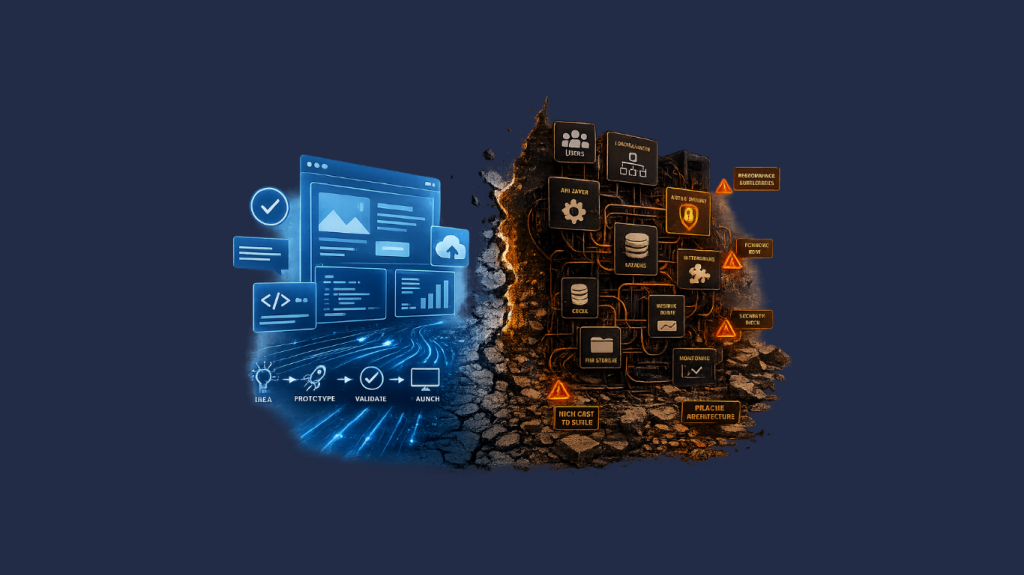

At some point, every SaaS team runs into the same question: how do we support multiple customers without building custom logic for each one?
On paper, multi-tenancy sounds straightforward. One application. Multiple customers. Shared infrastructure.
In practice, it’s one of the decisions that shapes everything that comes after—how you scale, how you secure data, even how you price your product.
Laravel has become a go-to framework for SaaS teams because it gives you flexibility without forcing a rigid structure. It makes it easier to get started and easier to make good decisions that could become painful later.
If you’re evaluating how to approach multi-tenancy, this isn’t really about syntax or packages. It’s about getting the architecture right early—especially if you’re planning to build a product that needs to grow.
If that’s already on your radar, it’s worth grounding the decision in how your platform will evolve, not just how fast you can launch. That’s where most teams start to lean on experienced partners for SaaS development services to avoid rework later.
What Multi-Tenancy Actually Means in Laravel
At its simplest, multi-tenancy means multiple customers (tenants) use the same application, with their data and experience isolated.
That isolation can happen in different ways.
Sometimes it’s purely logical. A tenant_id column separates records, and the application enforces boundaries. Other times it’s physical, with completely separate databases or schemas.
Laravel doesn’t force you into a single model. There’s no built-in “multi-tenancy mode.” Instead, it gives you the building blocks—middleware, database connections, service container bindings—to implement the approach that best fits your product.
That’s a big advantage. But it also means you’re responsible for choosing the right pattern.
Why Multi-Tenant SaaS Is Harder Than It Looks
Most teams underestimate multi-tenancy because they think of it as a database problem.
It’s not.
Data isolation is part of it, but the complexity spreads quickly:
- Authentication needs to understand which tenant a user belongs to
- Authorization has to enforce tenant boundaries at every layer
- Background jobs need to run in the correct tenant context
- Billing and usage tracking often vary by tenant
- Debugging becomes harder when multiple customers share infrastructure
And then there’s scale.
What works with 10 tenants doesn’t necessarily work with 1,000 or 10,000. Especially once you’re running in distributed environments or on cloud platforms like AWS, where performance and cost tradeoffs start to matter.
This is usually the point where teams realize they didn’t just choose a database structure. They chose an operational model.
Choosing the Right Multi-Tenant Architecture in Laravel
There isn’t a single “correct” approach. What matters is how well the model fits your current stage and future direction.
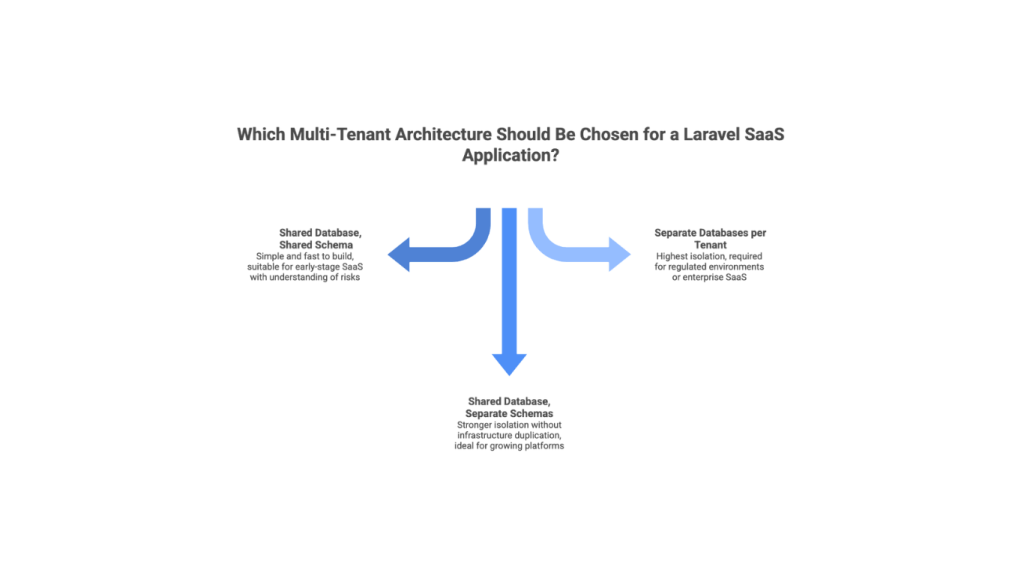
Shared Database, Shared Schema
This is the simplest option. All tenants share the same tables, typically separated by a tenant_id.
It’s fast to build and easy to manage early on. But it requires strict discipline. One missed filter or query can expose data across tenants.
For early-stage SaaS products, it’s often the right starting point—as long as you understand the risks.
Shared Database, Separate Schemas
Here, tenants share the same database server, but each has its own schema.
You get stronger isolation without duplicating the entire infrastructure. It’s a middle ground that works well for growing platforms that need more structure but aren’t ready for full separation.
The tradeoff is complexity. Migrations, deployments, and schema management become more involved.
Separate Databases per Tenant
Each tenant has its own database.
This offers the highest level of isolation and is often required for regulated environments or enterprise SaaS.
But it comes with real overhead. Provisioning, monitoring, backups, and migrations all scale with the number of tenants.
It’s powerful, but not something you adopt casually.
How Laravel Supports Multi-Tenancy Without Locking You In
Laravel doesn’t try to solve multi-tenancy for you. It gives you the pieces.
Middleware can identify tenants from domains, subdomains, or request data.
Database connections can be swapped dynamically.
The service container lets you bind tenant-specific services at runtime.
Even queues and jobs can be made tenant-aware with the right structure.
That flexibility is why Laravel works well for SaaS. You’re not fighting the framework as your application evolves.
But it also means you need to be deliberate. Laravel won’t stop you from building something that works today but struggles later.
👋 What do you need to support as your SaaS platform scales across tenants?
Curotec helps teams design and build multi-tenant Laravel applications that scale cleanly from early traction to enterprise growth—without costly architectural rewrites later.
Trusted by tech leaders at:



Laravel Multi-Tenancy Packages and Boilerplates
If you search for “Laravel multi-tenancy,” you’ll mostly find packages.
The most common ones are:
- Spatie/laravel-multitenancy
- Stancl/tenancy
They solve real problems:
- Identifying the current tenant
- Switching database connections
- Handling tenant lifecycle events
They can save time early on, especially if you’re building a SaaS MVP.
But they don’t solve the harder parts:
- How your data model evolves
- How your system scales
- How different tenants are segmented over time
That’s where teams sometimes get stuck. The package works, but the architecture underneath it wasn’t designed for growth.
Boilerplates help you move faster. They don’t replace architectural decisions.
Designing Tenant-Aware Systems Beyond the Database
Once you move past the database, things get more interesting.
Authentication and Access Control
Users need to belong to tenants. Roles and permissions need to be scoped correctly.
This gets complicated quickly if users can belong to multiple tenants or organizations.
Queues and Background Jobs
This is one of the most common failure points.
Jobs run asynchronously, often outside the request lifecycle. If they don’t carry tenant context correctly, you can end up processing data for the wrong customer.
Here is where thoughtful system design matters. It’s less about Laravel itself and more about how your application is structured. Many teams address this through broader application development architecture and system design that ensure consistency across the system.
File Storage and Assets
Tenant data doesn’t stop at the database.
Files, uploads, and generated assets need to be isolated as well. Whether you’re using S3 or another storage layer, you need a consistent strategy for separating tenant data.
Observability and Logging
Debugging multi-tenant systems is different.
You’re not just asking “what went wrong?” You’re asking, “For which tenant did this go wrong?”
Without tenant-aware logging and monitoring, issues become harder to trace and resolve.
Scaling Multi-Tenant Laravel Applications
Scaling isn’t just about adding more servers.
At some point, not all tenants should be treated the same.
Some generate more load. Some require stricter compliance. Some justify dedicated infrastructure.
That’s where tenant segmentation comes in.
You might start with a shared model, then gradually move high-value or high-risk tenants into isolated environments.
This kind of evolution is much easier if your architecture supports it from the start.
It also ties into broader data strategy decisions, especially if you’re building analytics or usage-based features. That’s often where teams bring in data engineering services partners to make sure tenant data remains usable at scale.
Common Mistakes Teams Make
A few patterns show up again and again:
- Treating multi-tenancy as a database decision only
- Over-engineering too early with full isolation
- Underestimating queue and job complexity
- Relying too heavily on boilerplates
- Not planning for tenant segmentation
None of these is fatal. But they do tend to slow teams down later.
When to Build Yourself vs When to Bring in a Partner
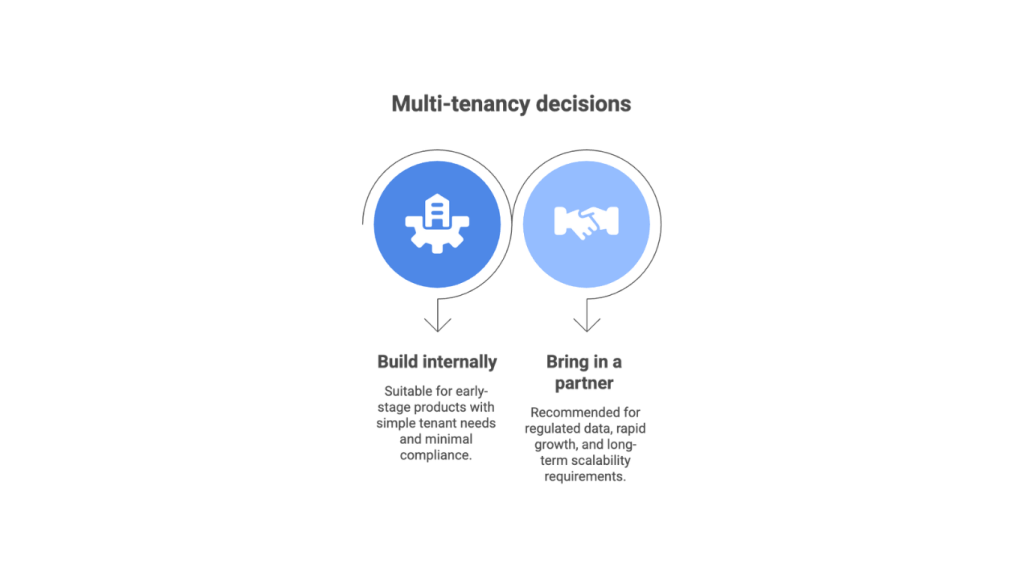
Some teams can handle multi-tenancy internally.
Usually, that’s when:
- The product is early-stage
- Tenant needs are relatively simple
- Compliance requirements are minimal
Other times, it makes more sense to bring in support early.
That tends to be the case when:
- You’re handling regulated data
- You expect rapid growth
- Your architecture needs to support long-term scalability
Multi-tenancy decisions are hard to unwind once they’re in place. Getting them right up front saves time, cost, and complexity later.
Where Multi-Tenant SaaS Is Headed
The model is evolving.
AI-driven workflows are increasingly interacting directly with application data. Infrastructure is becoming more dynamic. And SaaS platforms are moving toward more adaptive tenancy models instead of fixed structures.
Laravel is evolving alongside that shift, not by locking developers into a single pattern, but by continuing to support more complex, distributed systems.
That flexibility is still one of its biggest strengths.
Multi-tenancy isn’t just a feature you add. It’s a decision that shapes your entire SaaS platform.
Laravel gives you the tools to build it well. But it doesn’t make the decisions for you.
The earlier you think through those decisions—especially around architecture and scale—the easier it becomes to grow without running into limits later.
If you’re planning a SaaS platform or rethinking how your Laravel application handles multi-tenancy, it’s worth getting that foundation right. Contact Curotec to talk through your approach.