
Why Legacy PHP Still Runs Critical Applications
Many of the systems companies depend on every day are still powered by PHP. Not because anyone recently chose it, but because those applications were built years ago, expanded over time, and quietly became essential.
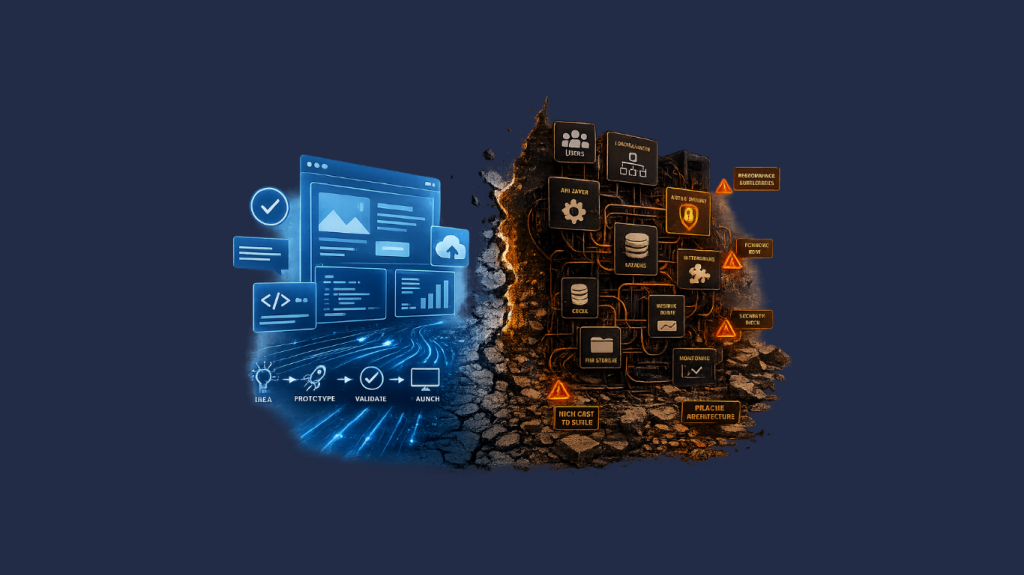
“Legacy” isn’t really about the language—it’s about how the system evolved. What started as a straightforward application often turned into something much harder to change as new features were layered in without a consistent structure.
Modernization, then, isn’t about abandoning PHP. It’s about making those systems easier to work with again—reducing risk, improving visibility, and giving teams a way to move forward without starting over.
For teams working through how to evolve these systems, engaging a partner experienced in custom software development can help bring structure without disrupting what already works.
What Legacy PHP Actually Looks Like in Practice
Most teams don’t inherit a single, cleanly defined “legacy system.” They inherit a mix of patterns that reflect years of incremental decisions.
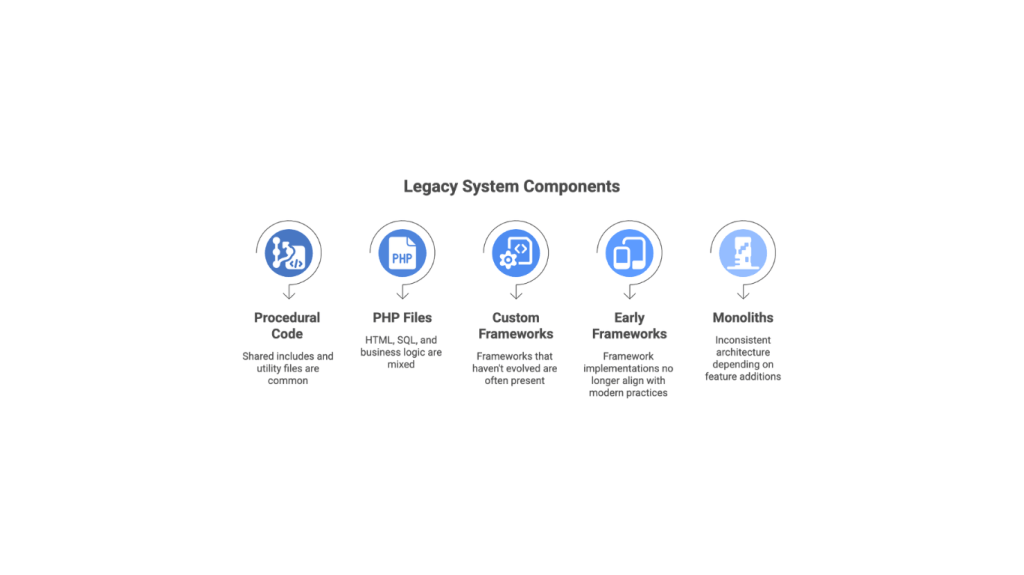
You’ll usually see some combination of:
- Procedural code with shared includes and utility files
- PHP files mixing HTML, SQL, and business logic
- Custom-built frameworks that haven’t evolved
- Early framework implementations that no longer align with modern practices
- Monoliths with inconsistent architecture, depending on when features were added
None of these, individually, is fatal. The problem is how they interact. Over time, dependencies become unclear, side effects multiply, and even small changes start to feel unpredictable. That’s the real signal that modernization is needed.
When PHP Becomes “Legacy”
It’s easy to assume a system becomes legacy just because it’s old. In reality, it’s more about how it behaves under change.
You’re in legacy territory when:
- Small updates require disproportionate effort
- Developers hesitate to touch certain parts of the codebase
- Bugs tend to resurface in unexpected places
- Delivery slows, even when requirements are simple
At that point, the issue isn’t PHP—it’s the lack of structure and confidence in the system.
The Hidden Cost of Leaving It Untouched
Leaving a legacy PHP system alone can feel like the safest option, especially if it’s still functioning. But over time, the cost shows up in ways that aren’t always obvious at first.
Feature delivery starts to slow down. Security risks increase as dependencies age. New developers take longer to onboard because nothing is consistent. Even infrastructure costs can rise as inefficiencies compound.
None of these happens overnight. That’s what makes them easy to ignore—and expensive to fix later.
Modernization vs. Rewrite
This is usually the moment where teams pause and ask, should we just start over?
On paper, a rewrite is tempting. You get to throw out everything that feels messy and rebuild it the “right” way. New framework, clean architecture, none of the baggage. But in practice, it rarely plays out that neatly. Timelines stretch. Edge cases get missed. And a lot of the business logic that quietly kept things working has to be rediscovered the hard way.
That’s why most teams end up adopting a more incremental approach, even if they didn’t plan it that way.
Instead of replacing everything, they start improving the system while it’s still in use. A piece here, a boundary there. Over time, the codebase starts to feel more predictable again.
A few patterns tend to emerge:
- Keeping the parts that already work and focusing effort where things are brittle
- Making small structural changes that reduce risk before tackling bigger ones
- Shipping improvements alongside normal feature work instead of pausing everything
This is where Laravel fits in naturally. Not as a big switch you flip, but as something you introduce where it makes sense. New endpoints, new services, cleaner data access. Bit by bit, more of the system starts to follow those patterns.
Step One: Stabilize the Existing Application
Before introducing anything new, the system needs to be stable enough to support change. That usually means addressing the basics that have been deferred over time.
Start by bringing the runtime and dependencies into a supported state. Add proper error handling and logging so you can actually see what the application is doing. If Composer isn’t in place, introduce it and begin explicitly managing dependencies.
This step doesn’t change the architecture yet, but it removes a lot of the uncertainty that makes modernization risky in the first place.
Step Two: Introduce Structure Without Rewriting
Once the system is stable, the next step is to create some internal boundaries. Not a full redesign—just enough structure to make the code more predictable.
This often involves:
- Separating business logic from presentation
- Introducing namespaces and autoloading
- Reducing reliance on the global state
- Wrapping fragile legacy code behind clear interfaces
Laravel can start to play a role here even before a full migration. Adopting its conventions—like organized controllers, services, and configuration—helps bring consistency to parts of the system without requiring a complete rebuild.
Step Three: Use the Strangler Fig Pattern with Laravel
This is where modernization starts to feel real.
The strangler fig pattern lets you gradually replace parts of the system instead of doing it all at once. New functionality is built in a modern layer, while legacy components continue to run until they can be retired.
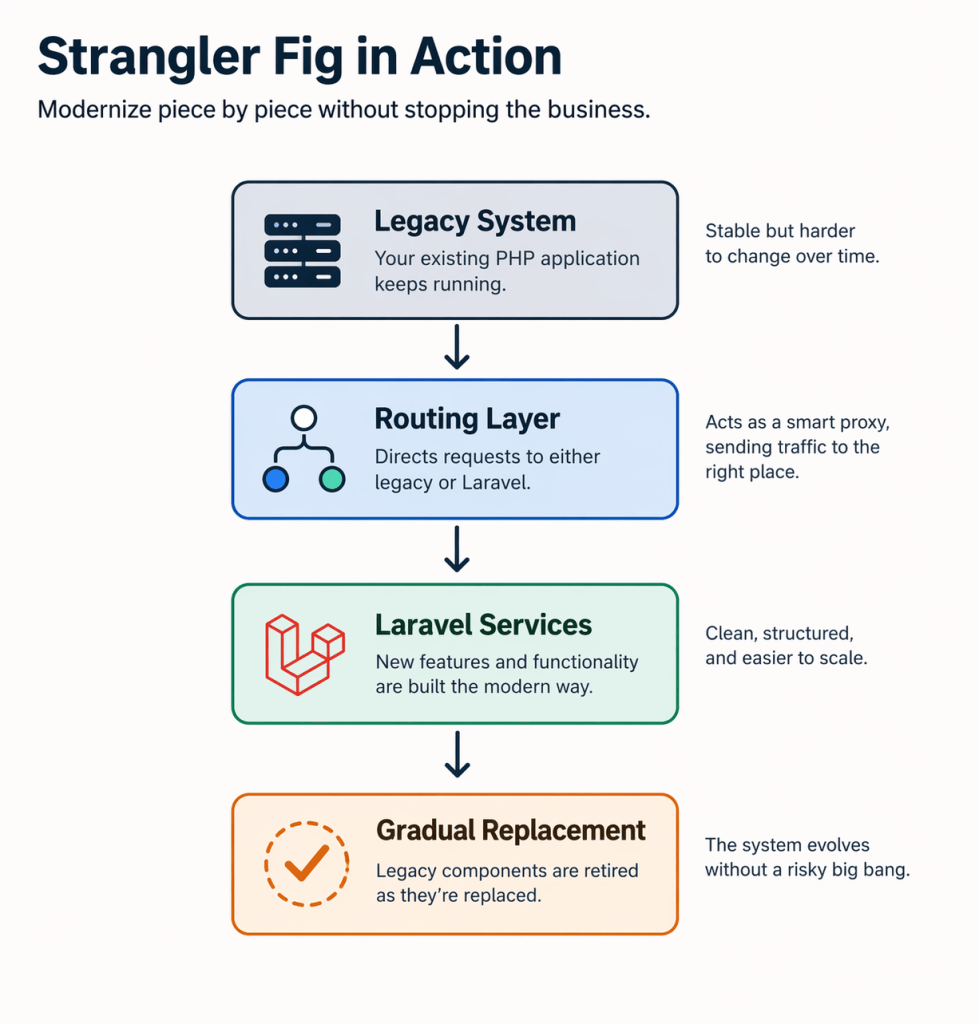
Laravel is a natural fit for this approach. You can introduce it alongside the existing application and begin routing new functionality through it. Over time, more of the system shifts into that structured environment.
Practically, that looks like:
- Building new features in Laravel while leaving legacy code untouched
- Routing specific requests through Laravel endpoints
- Sharing authentication, sessions, and data between systems
- Gradually decommissioning legacy components as they’re replaced
At the same time, deploying Laravel in a cloud environment—whether via Laravel Cloud, Forge, or a custom setup—also modernizes the operational side. The Laravel Cloud approach separates infrastructure from code, introduces scalable deployment patterns, and makes the system easier to manage over time.
Step Four: Modernize Data Access
Data is often where legacy systems are most fragile. Queries are scattered across the codebase, tightly coupled to business logic, and difficult to change safely.
Modernizing this layer creates a ripple effect across the entire application.
With Laravel, you can begin to:
- Centralize database access through models
- Introduce migrations and schema versioning
- Improve transaction handling and consistency
- Reduce direct coupling between logic and database structure
Once data access becomes predictable, other parts of the system become much easier to refactor.
Step Five: Build Confidence Through Testing and Automation
Modernization doesn’t work if every change still feels risky. That’s where testing and automation come in.
You don’t need perfect coverage to start. Focus on the flows that matter most—revenue paths, critical user actions, and core business logic. Add tests around those areas before making changes.
From there, introduce:
- Automated builds
- CI pipelines
- Repeatable deployments
Laravel’s testing tools make this much more approachable, especially compared to retrofitting tests into unstructured legacy code.
👋 Need help moving your legacy PHP application forward without a full rewrite?
Curotec helps teams modernize PHP incrementally using Laravel, improving structure, scalability, and long-term maintainability without disrupting existing systems.
Trusted by tech leaders at:



When to Decompose the Monolith
At some point, the question of microservices comes up. It’s an important one, but it’s often asked too early.
In many cases, a well-structured Laravel-based monolith is exactly what the system needs. It provides clarity and maintainability without introducing the overhead of distributed systems.
If you’re evaluating whether to go further, it’s worth reviewing the trade-offs in this guide on monolith vs microservices.
Decomposition makes sense when scaling needs diverge or when domains are clearly defined. Otherwise, it tends to add complexity faster than it adds value.
What Modern PHP Actually Looks Like
There’s still a perception that PHP is outdated, but that hasn’t been true for a while.
A modern PHP application—especially one built on Laravel and deployed in a cloud environment—is structured, testable, and maintainable. It supports clear architectural patterns, integrates well with modern infrastructure, and gives teams the tools they need to move quickly without sacrificing stability.
That’s a very different picture from the legacy systems many teams are dealing with today.
Common Mistakes to Avoid
Even with the right tools, modernization can go sideways if the approach isn’t grounded.
A few patterns to watch for:
- Treating modernization as a one-time project instead of an ongoing process
- Jumping into a full rewrite before stabilizing the system
- Ignoring deployment and infrastructure considerations
- Over-engineering early in the process
- Migrating to a new framework without addressing the underlying architectural issues
Laravel helps, but it’s most effective when it’s introduced thoughtfully, as part of a broader strategy.
Legacy PHP doesn’t have to be something teams work around. With the right approach, it can become something they build on.
By using Laravel as the target architecture and the Strangler Fig pattern as the path forward, teams can modernize in a way that reduces risk rather than increasing it. They can improve delivery speed, restore consistency to the codebase, and extend the life of systems that still matter to the business.
The key is not trying to do everything at once. The most successful modernizations are those that build on where the system is today.
If your team is evaluating how to modernize a legacy PHP application and wants a clearer, lower-risk path forward, Curotec can help you implement Laravel-based architectures, cloud deployment strategies, and incremental modernization plans that actually work in practice.
Contact Curotec to start the conversation.