Laravel Octane gets talked about like it’s an easy win. Flip a switch, unlock serious performance gains, and move on.
That’s not how it plays out in most real applications.
Some teams do see meaningful improvements. Others go through the effort of implementing it and realize very little actually changed. In a few cases, things get more complicated without any real upside.
The difference usually comes down to one thing: where the bottlenecks actually are.
If your team is already thinking about performance at that level, solutions like Octane make sense. And if you’re still figuring that out, it’s often worth stepping back before introducing more moving parts. That’s typically where working with a team experienced in Laravel development can save significant time.
What Laravel Octane Actually Changes
At a high level, Octane shifts how Laravel handles requests.
Normally, every request boots the framework from scratch. That includes loading the configuration, resolving dependencies, and initializing services.
Octane removes that repetition.
Instead of starting fresh each time, it keeps the application in memory and reuses it across requests. That sounds like a small change, but it fundamentally alters how the application behaves under load.
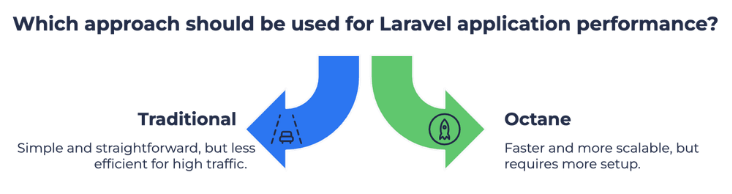
You go from a stateless request cycle to something that’s effectively long-running. This shift is easier to see when you compare the two models side by side:
That’s where both the performance gains and the tradeoffs come from.
Where the Performance Gains Actually Come From
It’s easy to say Octane is faster. The more useful question is why.
A few things are happening under the hood:
- The framework doesn’t need to re-bootstrap on every request
- Dependency resolution happens once instead of repeatedly
- Certain operations stay warm in memory
- Concurrent requests can be handled more efficiently
In isolation, each of these is incremental. Together, they can add up.
But there’s an important limitation that often gets overlooked.
Octane doesn’t fix slow queries. It doesn’t optimize external API calls. It doesn’t clean up inefficient business logic.
It just removes overhead from the framework itself. This is often where teams realize the real issue isn’t the framework at all, but how the application is structured, something that typically surfaces during broader custom software development work.
So if your performance issues lie elsewhere, Octane won’t move the needle much.
Laravel Octane Benchmarks: What Actually Changes
Most published benchmarks don’t accurately reflect reality. They tend to focus on a single endpoint, minimal logic, no database pressure, and perfectly controlled conditions.
That’s useful for showing theoretical gains, but it doesn’t map cleanly to production systems.
Real benchmarking looks different. In practice, getting this right usually requires a controlled testing approach that mirrors production behavior, not just isolated endpoint tests, something teams often build into their QA engineering process over time.
You’re dealing with:
- Mixed read and write operations
- Authenticated and unauthenticated traffic
- Database queries that vary in complexity
- External services that introduce latency
- Background jobs competing for resources
When you test Octane in that kind of environment, a few patterns usually emerge.
Response times improve under sustained load, not just peak scenarios. Latency becomes more consistent, which often matters more than raw speed. At the same time, memory usage goes up, sometimes significantly, and that needs to be managed deliberately.
And in applications where the database or external services dominate response time, the gains are much smaller than expected.
👋 What’s actually slowing your Laravel application down right now?
Curotec helps teams pinpoint real bottlenecks and determine whether solutions like Octane will deliver measurable gains or just add complexity.
Trusted by tech leaders at:



Swoole vs RoadRunner: What Actually Matters
If you’re evaluating Octane, this decision comes up quickly.
Both Swoole and RoadRunner enable the same core idea. The differences show up in how they behave operationally.
Swoole
Swoole is a native PHP extension, which gives it a higher performance ceiling and more advanced async capabilities.
That also makes it more opinionated.
Setup can be more involved, especially across environments. It introduces additional considerations around extensions, compatibility, and deployment consistency.
Where it shines is in scenarios where you’re pushing performance limits or need fine-grained control over concurrency.
RoadRunner
RoadRunner takes a different approach. It runs as a Go-based application server and communicates with PHP workers.
In practice, it’s easier to drop into an existing setup.
Deployment tends to be more predictable, especially for teams already comfortable with containerized environments. It doesn’t offer the same depth of async features as Swoole, but for most applications, that tradeoff is acceptable.
Most teams evaluating Octane today ultimately choose RoadRunner for its operational simplicity, while performance-focused environments may lean toward Swoole. Increasingly, however, teams are also evaluating FrankenPHP as part of their broader Laravel performance strategy.
Swoole becomes the better option when performance tuning is a primary concern, and the team is comfortable managing the added complexity.
What About FrankenPHP?
No discussion about Laravel performance optimization in 2026 is complete without mentioning FrankenPHP.
While FrankenPHP is not an Octane driver today in the same way Swoole and RoadRunner are, it has quickly become one of the most interesting runtime options in the PHP ecosystem. Built on top of the Caddy web server, FrankenPHP combines modern application serving with features traditionally associated with dedicated application servers.
For many teams, FrankenPHP’s appeal is simplicity. Deployment is often more straightforward than Swoole, and it avoids some of the architectural complexity that comes with introducing a separate Go-based process manager like RoadRunner.
Its growing adoption within the Laravel community has also led many developers to view it as a potential long-term standard for high-performance PHP applications.
Where FrankenPHP Fits
- Teams looking for a simpler deployment model
- Containerized environments where operational simplicity matters
- Applications seeking performance improvements without introducing significant infrastructure complexity
- Organizations already standardizing on modern PHP runtimes
The Important Caveat
FrankenPHP and Octane solve related but not identical problems.
Octane focuses on keeping Laravel resident in memory and eliminating framework bootstrapping overhead. FrankenPHP focuses on modern application serving and runtime performance.
Depending on the application, teams may evaluate both technologies as part of the same performance optimization strategy rather than treating them as direct replacements.
When Laravel Octane Makes Sense
Octane isn’t a default upgrade. It’s a targeted optimization.
It works well in situations where framework overhead is a significant contributor to response time.
That usually includes:
- High-throughput APIs with repeated request patterns
- Applications handling steady, consistent traffic
- Systems where latency consistency matters as much as speed
- Workloads that benefit from keeping data warm in memory
You’ll often see stronger results in SaaS platforms, internal tools with heavy API usage, or dashboards where similar queries are executed repeatedly.
When Laravel Octane Is the Wrong Choice
This is where many teams get tripped up.
If your application has low traffic, Octane is unlikely to make a noticeable difference.
If most of your latency comes from database queries or third-party APIs, it won’t help much there either.
And if your team isn’t used to working with long-lived processes, the learning curve can introduce new risks.
A few common issues show up repeatedly:
- Memory leaks caused by unintended shared state
- Bugs that only appear under concurrency
- More complicated debugging workflows
- Infrastructure that wasn’t designed for this model
In those cases, stepping back and aligning architecture with business requirements usually delivers more value than introducing new runtime complexity, which is often where application modernization efforts begin.
In those cases, simpler optimizations usually deliver better returns with less effort.
The tradeoffs Teams Underestimate
The biggest shift with Octane isn’t performance. It’s how you think about the application lifecycle.
Laravel developers are used to stateless execution. Every request starts clean.
Octane changes that assumption.
The state can persist longer than expected. Memory needs to be monitored. Restart strategies become part of your deployment process. That shift often catches teams off guard, especially if deployment workflows weren’t originally designed for long-running processes, something that tends to surface during broader platform and infrastructure planning.
Observability also becomes more important. You need better visibility into how the application behaves over time, not just per request.
That’s where teams often feel the impact the most.
Laravel Performance Optimization Goes Beyond Octane
Octane is one piece of a much larger picture.
In many cases, the biggest gains come from areas that are less visible but more impactful:
- Query optimization and indexing
- Caching strategies using Redis or application-level caching
- Efficient job and queue handling
- Reducing unnecessary external calls
If you’re working in a cloud environment, infrastructure decisions also play a role. Scaling patterns, load balancing, and resource allocation can have just as much impact as application-level changes. This is often where teams start aligning performance improvements with broader Application Development Services and AWS Cloud Services decisions.
How to Evaluate Whether Octane is Worth It
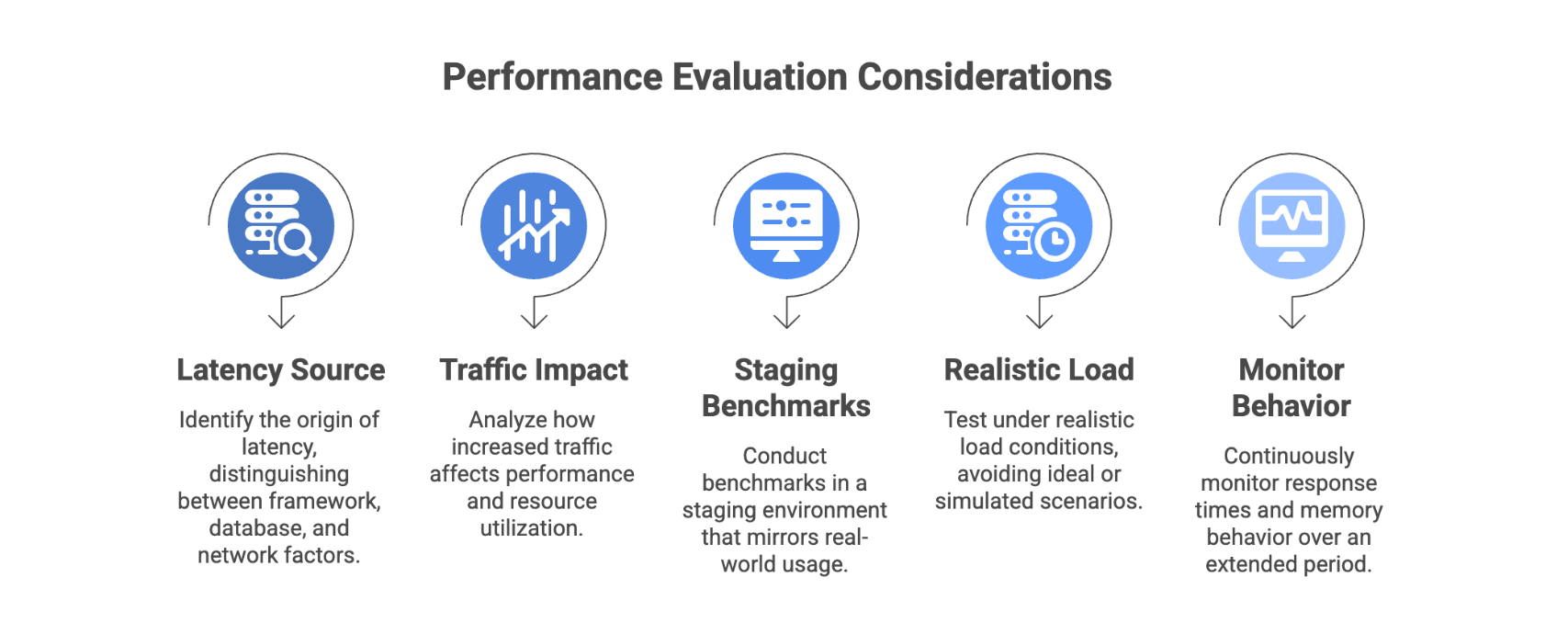
Before introducing Octane, it helps to answer a few basic questions.
Where is your latency actually coming from? How much of it is framework overhead versus database or network time? What happens when traffic increases?
A simple approach works best.
Run benchmarks in a staging environment that reflects real usage. Test under realistic load, not ideal conditions. Monitor both response times and memory behavior over time.
In many cases, that exercise alone clarifies the decision.
A More Realistic Way to Think About Octane
Whether the answer is Octane, RoadRunner, Swoole, FrankenPHP, or simply better application architecture, the goal should always be the same: identify the actual bottleneck before introducing additional complexity.le.
It’s something you reach for when you’ve already identified where your system is leaking performance.
Used in the right context, it can improve performance in a noticeable, meaningful way. Used too early, it tends to shift complexity rather than solve the underlying problem.
That distinction matters more than any benchmark.
Laravel Octane can absolutely improve performance. But it’s not universal or automatic.
The teams that get the most value from it are those that treat it as part of a broader performance strategy, not as a starting point.
If you’re evaluating whether it makes sense for your application, or trying to understand where your system is actually slowing down, it’s worth getting a second perspective before making changes that are harder to unwind later. Contact Curotec to take a more measured, architecture-first approach to performance optimization.